Quebec City Travel Guide: Everything You Need to Know for 2026
Your complete guide to visiting North America’s most European city
Table of Contents
- Quebec City Overview
- Getting There & Around
- Top Attractions & Landmarks
- Neighborhoods & Districts to Explore
- Food & Dining
- Nightlife & Entertainment
- Shopping
- Seasonal Events & Festivals
- Accommodation Recommendations
- Practical Information
- Day Trips & Nearby Destinations
- Insider Tips & Hidden Gems
- Money-Saving Tips
- Common Tourist Mistakes to Avoid
- Sample Itineraries
- Frequently Asked Questions
1. Quebec City Overview
Quebec City is a magical destination where cobblestone streets wind past 400-year-old stone buildings, French is the language of daily life, and you can walk along fortress walls that once defended New France. It’s the only fortified city north of Mexico, and stepping through its gates feels like traveling back in time to 17th-century Europe. The narrow streets of Old Quebec are filled with bistros, art galleries, and horse-drawn carriages that clip-clop over ancient stones.
You should visit Quebec City because it offers a completely unique experience in North America. Where else can you sip café au lait in a centuries-old French café, explore a UNESCO World Heritage Site, and then stay in a hotel made entirely of ice? The city combines rich French colonial history with vibrant modern culture, outstanding cuisine that rivals anywhere in Europe, and some of the most photogenic architecture on the continent. Whether you’re exploring the towering Château Frontenac, wandering the artistic Quartier Petit Champlain, or watching the St. Lawrence River from the Dufferin Terrace, Quebec City enchants visitors with its old-world charm.
The city does get extremely cold in winter with temperatures dropping to -15°C to -25°C, and summer can bring tourist crowds to Old Quebec’s narrow streets. However, the winter transforms the city into a snowy wonderland perfect for the famous Winter Carnival, and even in peak summer, you can find quiet corners just a few blocks from the main attractions. The city is compact enough to explore on foot, making it accessible for all types of travelers.
Best Time to Visit Quebec City
Spring (April-May): Spring brings temperatures from 5°C to 15°C, with occasional rain showers and the last bits of snow melting away. Crowds are minimal and prices are lower than summer, making this an excellent shoulder season for budget travelers. The city starts to bloom, outdoor cafés reopen their terraces, and locals emerge from their winter hibernation with palpable energy. You’ll find good hotel deals and can explore attractions without lineups.
Summer (June-August): Peak season brings warm temperatures of 20°C to 28°C, long sunny days perfect for exploring, and festivals nearly every week. This is when Quebec City is most alive with outdoor dining, street performers, and the spectacular Summer Festival in July. However, expect crowds at major sites like the Château Frontenac and Petit Champlain, higher hotel prices, and the need to book popular restaurants in advance. The weather is ideal for walking tours and outdoor activities.
Fall (September-October): Autumn is spectacular as the surrounding forests explode in red, orange, and gold foliage, creating postcard-perfect views from the city walls. Temperatures range from 10°C to 18°C, crowds thin out after Labor Day, and the lighting for photography is absolutely stunning. This is many locals’ favorite season to explore the city. You’ll find good hotel rates and the crisp air makes walking tours especially pleasant.
Winter (November-March): Winter transforms Quebec City into a snowy fairy tale, with temperatures from -10°C to -25°C and frequent snowfall creating a magical atmosphere. The famous Winter Carnival in February brings ice sculptures, snow slides, and the iconic Ice Hotel. Hotel rates are lowest (except during Carnival), and the city is beautifully decorated with Christmas lights. You’ll need serious winter gear, but the experience of walking through snow-covered Old Quebec is unforgettable. Indoor attractions and cozy restaurants provide warm respites.
How Long to Stay in Quebec City
- 1-2 days: You can see the main highlights of Old Quebec in a rushed weekend trip. Walk the fortifications, visit Château Frontenac, explore Petit Champlain, and grab a meal on Grande Allée. It’s possible but very rushed, best for those on a Montreal-Quebec City combination trip or cruise passengers with limited time.
- 3-4 days: Perfect for first-time visitors and the ideal length to experience Quebec City properly. You’ll have time to explore Upper and Lower Town thoroughly, take a day trip to Montmorency Falls or Île d’Orléans, enjoy multiple excellent meals, and still have time to wander and discover hidden corners. This allows for a relaxed pace without feeling rushed.
- 5-7 days: Ideal for deep exploration and really soaking in the French-Canadian culture. You can take multiple day trips, explore beyond Old Quebec into neighborhoods like Saint-Roch, visit the Ice Hotel in winter, take cooking classes, and enjoy the city like a local. This length allows for museum visits, shopping, and perhaps catching a show or concert.
- 1 week+: For Quebec enthusiasts or those combining it with winter activities. You can explore every district, take day trips to Quebec’s countryside, try every type of poutine, visit multiple sugar shacks in spring, or enjoy extended winter sports. This length works well for digital nomads or those wanting to truly live the Quebec experience.
Quick Facts About Quebec City
- Population: 542,000 (city), 839,000 (metro area)
- Language: French (95% speak French, 40% speak some English in tourist areas)
- Currency: Canadian Dollar (CAD or $)
- Time Zone: Eastern Standard Time (EST/UTC-5, EDT/UTC-4 in summer)
- Country Code: +1
- Area Code: 418 and 581
2. Getting There & Around
Airports Serving Quebec City
Québec City Jean Lesage International Airport (YQB)
505 Rue Principale, Québec, QC G2G 0J4, Canada
Located 16 km west of downtown, this is Quebec City’s main airport serving domestic flights from across Canada and seasonal international flights to the US, Mexico, and Europe. Air Canada, WestJet, and Porter Airlines are the main carriers.
Montréal-Pierre Elliott Trudeau International Airport (YUL)
975 Romeo-Vachon Blvd N, Dorval, QC H4Y 1H1, Canada
Located 250 km southwest, Montreal’s larger airport offers many more international connections. Consider flying here if you can’t find good flights to Quebec City, then take the bus or train for a 3-hour journey.
[AFFILIATE LINK: Find cheap flights to Quebec City – Skyscanner/Expedia]
Getting from Airport to City Center
Airport Shuttle Bus (RTC 76/80): $3.75 CAD per person, approximately 45-60 minutes depending on traffic. The RTC public bus route 76 runs to downtown during peak hours, while route 80 operates evenings and weekends. Buses depart from outside the terminal every 30-60 minutes. Purchase tickets on the bus with exact change or use the Nomade transit app.
Taxi: $35-40 CAD fixed rate to downtown, approximately 20-25 minutes. Official taxis wait outside arrivals with clearly marked fare zones. All taxis accept credit cards. Look for licensed taxis with official meters and company markings.
Rideshare (Uber): $30-45 CAD depending on time and demand, approximately 20-25 minutes. Uber is available at Quebec City airport with designated pickup zones. Download the app and check for surge pricing during peak times.
Rental Car: $40-80 CAD per day depending on vehicle type. Major companies (Enterprise, Hertz, Avis, Budget) have counters in the arrivals hall. A car is unnecessary for exploring Old Quebec but useful for day trips to surrounding regions.
Private Transfer: $50-70 CAD for door-to-door service to your hotel. Book through your hotel or private transfer companies for convenience, especially with luggage or in winter weather.
[AFFILIATE LINK: Book airport transfers to Quebec City – GetYourGuide/Viator]
Getting Around Quebec City
Quebec City is wonderfully walkable, especially in Old Quebec where most attractions are concentrated within a 1-2 km radius. The historic district is built on two levels connected by staircases and a funicular, creating a compact, pedestrian-friendly area perfect for exploring on foot. The Réseau de transport de la Capitale (RTC) operates an excellent bus network throughout the city, though you’ll mainly need it for trips outside Old Quebec. In winter, the city remains walkable but be prepared for icy sidewalks and cold temperatures.
Public Transit (RTC Bus Network)
The RTC operates over 120 bus routes covering Greater Quebec City, with frequent service throughout the day. Buses are modern, clean, heated in winter, and most routes operate from 6am to midnight, with some night buses until 1am. The system is efficient and affordable, though you’ll primarily use it for reaching attractions outside Old Quebec like Montmorency Falls or the suburbs.
Tickets & Passes:
- Single ride: $3.75 CAD (valid for 90 minutes with unlimited transfers)
- 2-trip ticket: $7 CAD
- 10-trip card: $32 CAD
- 1-day pass: $9.50 CAD (unlimited rides until 5am next day)
- 3-day pass: $23.75 CAD
- Weekly pass: $28.75 CAD (Monday to Sunday)
Purchase tickets at the airport, major transit stations, dépanneurs (convenience stores), or use the Nomade transit app for mobile tickets. Paper tickets must be validated in the machine when boarding. Drivers do not sell tickets or make change, so have exact fare or buy in advance.
Funicular (Old Quebec Cable Car)
The famous funicular connects Lower Town (Quartier Petit Champlain) with Upper Town (near the Château Frontenac), climbing a steep 64-meter cliff in just 90 seconds. It runs daily from 7:30am to 11pm (later in summer), departing every few minutes. Single ride is $4 CAD, or buy a round trip for $6 CAD. It’s a charming experience and saves climbing the steep Escalier Casse-Cou (Breakneck Stairs), though the stairs themselves are worth descending for photos and the adventure.
Taxis & Rideshare
Official taxis are white with rooftop lights and company markings. They use meters with a $3.75 starting fare plus $1.90 per kilometer. All accept credit cards. You can hail taxis on major streets, find them at stands near hotels and attractions, or call Taxi Coop (418-525-5191) or Taxi Quebec (418-525-8123).
Uber operates throughout Quebec City with standard pricing around 20-30% less than taxis in normal conditions. Surge pricing can make Uber more expensive during peak times, bad weather, or special events. The app works well and drivers are readily available in tourist areas.
Walking
Walking is the absolute best way to experience Quebec City, especially in Old Quebec where cobblestone streets, hidden courtyards, and architectural details reveal themselves around every corner. The entire fortified area is about 2 km across and easily walkable in 30-40 minutes without stops. Streets are well-maintained with clearly marked pedestrian crossings, though cobblestones can be uneven and very slippery when wet or icy.
Walkability Score: 95/100 for Old Quebec and downtown. Everything from Château Frontenac to the Port of Quebec is within a 20-minute walk. The Plains of Abraham, Parliament Hill, and Grande Allée are all easily accessible on foot.
Biking
Quebec City has been improving bike infrastructure with dedicated lanes along major routes, though Old Quebec’s steep hills and cobblestones make cycling challenging. The Corridor du Littoral offers beautiful flat cycling along the St. Lawrence River. BIXI bike-share doesn’t operate here, but you can rent bikes from Cyclo Services (160 Quai St-André) for $35-45 CAD per day. Best for experienced cyclists comfortable with hills and traffic.
Car Rentals
You don’t need a car in Quebec City proper. Parking is expensive ($3-5 per hour), scarce in Old Quebec, and the narrow streets are challenging to navigate. However, a car is valuable for day trips to Montmorency Falls, Île d’Orléans, Charlevoix region, or skiing in winter. Major rental companies are at the airport and downtown. Expect $50-90 CAD per day plus gas. In winter, winter tires are mandatory by law from December 1 to March 15.
Tourist Passes & Cards
Quebec City doesn’t have a comprehensive tourist card like some European cities, but consider the Mega Pass which includes entry to multiple attractions for $69.99 CAD adults, $34.99 children. It covers Aquarium du Québec, Musée de la Civilisation, and other sites. Calculate whether it saves money based on your itinerary. The pass doesn’t include transportation.
[DISPLAY AD PLACEHOLDER #1]
3. Top Attractions & Landmarks
[AFFILIATE LINK: Book skip-the-line tickets for Quebec City attractions – GetYourGuide/Viator]
Château Frontenac
1 Rue des Carrières, Québec, QC G1R 4P5, Canada
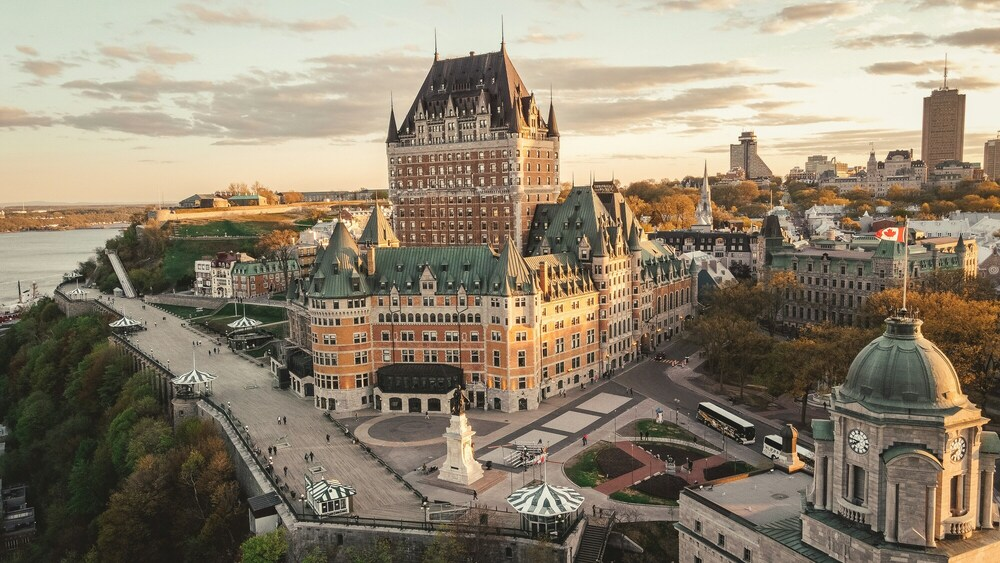
The Château Frontenac is Quebec City’s most iconic landmark and one of the most photographed hotels in the world. This grand railway hotel was built in 1893 in the French Renaissance château style, with its distinctive green copper roofs, turrets, and towers dominating the Old Quebec skyline. The building sits dramatically atop Cap Diamant, the clifftop site where French explorer Samuel de Champlain first established a settlement in 1608. The hotel has hosted royalty, celebrities, and world leaders including Winston Churchill and Franklin Roosevelt during the 1943 Quebec Conference.
The château contains 611 luxury rooms, multiple restaurants, and lavish public spaces decorated with rich woods, brass fixtures, and period furniture. Even if you’re not staying here, you can explore the ground floor public areas, which include the grand lobby with its soaring ceilings and elegant décor. The hotel has been a National Historic Site of Canada since 1980.
Why visit: This is Quebec City’s defining image and walking through its halls gives you a sense of the grandeur and history that makes this city special. The architecture alone is stunning, and the views from the terrace outside are among the best in the city, overlooking the St. Lawrence River and Lower Town. Even walking around the exterior and photographing this magnificent building from different angles is worthwhile.
Entrance: Free to walk around public areas; guided tours $19.95 CAD adults, $10.95 CAD children (6-17)
Best time: Early morning (7-9am) or evening (sunset) for photos with fewer people
Hours: Hotel lobby accessible 24/7; tours available 10am-6pm daily
Old Quebec Historic District (Vieux-Québec)
Quartier du Vieux-Québec, Québec, QC, Canada (center: Place d’Armes)
Old Quebec is a UNESCO World Heritage Site and the only fortified city north of Mexico with its defensive walls still intact. The district is divided into Upper Town (Haute-Ville) and Lower Town (Basse-Ville), connected by staircases and the famous funicular. Walking these narrow, winding cobblestone streets feels like stepping into a European city from the 17th and 18th centuries, with stone buildings, church spires, and charming squares at every turn.
The fortifications themselves stretch for 4.6 kilometers and include four gates, three towers, and two bastions. The historic district is compact, covering less than 2 square kilometers, but it’s packed with architectural treasures, boutique shops, museums, galleries, and some of Quebec’s best restaurants. Every building tells a story, from the simple stone houses that survived multiple fires to the grand Victorian structures built during the city’s heyday as a major port.
Why visit: This is the heart and soul of Quebec City, where you’ll spend most of your time. The entire district is essentially an outdoor museum where you can experience French colonial life while enjoying modern amenities. Simply wandering without a map and discovering hidden courtyards, tiny chapels, and cozy cafés is one of the great pleasures of visiting Quebec City. The atmosphere is magical year-round, but especially enchanting under snow or during evening strolls when gas-style streetlamps illuminate the old stones.
Entrance: Free to walk around (UNESCO site); individual attractions have separate fees
Best time: Early morning (before 9am) or evening (after 7pm) to avoid cruise ship crowds
Hours: Public streets accessible 24/7; shops and attractions typically 10am-6pm
Citadelle of Quebec (La Citadelle)
1 Côte de la Citadelle, Québec, QC G1R 3R2, Canada
The Citadelle is the largest British-built fortress in North America, an active military installation that has been continuously occupied since 1850. Built between 1820 and 1850 on the strategic promontory of Cap Diamant, the star-shaped fortress was designed to defend against American invasion that never came. Today it serves as the home and training grounds of Canada’s Royal 22nd Regiment (the “Van Doos”) and the summer residence of the Governor General of Canada.
The fortress covers 2.3 square kilometers with massive stone ramparts, powder magazines, barracks, and a network of underground passages. Visitors can see the original cannons still pointing across the St. Lawrence River, explore the museum with its collection of military artifacts and regimental history, and visit the summer residence. The architecture is impressive military engineering from the height of the British Empire, designed to withstand artillery bombardment with its thick walls and strategic positioning.
Why visit: The Citadelle offers the most comprehensive military history experience in Quebec City and spectacular panoramic views of the St. Lawrence River, the Old Port, and surrounding region from its elevated position. The Changing of the Guard ceremony (late June through early September, 10am daily) is a colorful tradition worth seeing, featuring soldiers in ceremonial red tunics and bearskin hats. Guided tours provide fascinating insights into military life, defensive strategies, and Canadian history.
Entrance: $18 CAD adults, $15 CAD seniors/students, $9 CAD youth (6-17), under 6 free
Best time: Morning tour at 10am to see Changing of Guard (summer only), or afternoon for best light
Hours: November-April: 10am-3pm; May-October: 9am-5pm (guided tours only, last tour 1 hour before closing)
Quartier Petit Champlain
Rue du Petit-Champlain, Québec, QC G1K 4H5, Canada
Quartier Petit Champlain is North America’s oldest commercial district and possibly its most charming. Nestled at the base of Cap Diamant cliff in Lower Town, this pedestrian-only neighborhood of narrow cobblestone lanes dates back to 1608. The district centers on Rue du Petit-Champlain, a picturesque street barely wide enough for two people to walk side-by-side, lined with centuries-old stone buildings that have been lovingly restored and painted in cheerful colors.
The quarter is home to over 50 boutiques selling Quebec-made crafts, art galleries featuring local artists, cozy cafés, and excellent restaurants tucked into historic buildings with stone walls and wooden beams. Every corner is Instagram-worthy, with hanging flower baskets in summer, twinkling lights year-round, and snow-dusted rooftops in winter. The famous Breakneck Stairs (Escalier Casse-Cou) connect Petit Champlain to Upper Town, earning their name from the steep, treacherous descent.
Why visit: This is where Quebec City’s European charm is most concentrated. Shopping here means finding unique Quebec-made items rather than mass-produced souvenirs, from hand-blown glass to Indigenous art. The restaurants and cafés are authentic rather than touristy, serving excellent French-Canadian cuisine in romantic settings. Even if you’re not shopping, simply strolling these ancient streets with a coffee in hand, watching street musicians perform, and soaking in the atmosphere is magical. At Christmas, the decorations are absolutely enchanting.
Entrance: Free to explore (outdoor pedestrian district)
Best time: Early morning (before 10am) for photos without crowds; evening for romantic atmosphere
Hours: Public streets 24/7; shops typically 9:30am-5:30pm (extended in summer)
Terrasse Dufferin (Dufferin Terrace)
1 Rue des Carrières, Québec, QC G1R 4P5, Canada
Terrasse Dufferin is a magnificent wooden boardwalk stretching 425 meters along the clifftop next to Château Frontenac, offering sweeping views of the St. Lawrence River, Lévis on the opposite shore, and Île d’Orléans in the distance. Built in 1879 and named after Governor General Lord Dufferin, the terrace is elevated 60 meters above Lower Town, creating a natural promenade where locals and visitors stroll, relax on green benches, and take in the spectacular scenery.
The boardwalk features ornate Victorian-style lampposts, gazebos, and kiosks selling ice cream and souvenirs. Street performers, artists, and musicians entertain crowds, especially in summer. In winter, a portion transforms into the famous Toboggan Slide, where you can rocket down an 820-meter ice track at speeds up to 70 km/h. The terrace connects to the Promenade des Gouverneurs, which continues along the cliff toward the Citadelle, offering even more dramatic views.
Why visit: This is where locals and tourists gather to experience Quebec City’s most iconic views. Watching the sun set over the St. Lawrence River from these wooden boards is a quintessential Quebec experience. The terrace is free, accessible to everyone, and beautiful in every season. Whether you’re sipping coffee on a summer morning, watching ships pass on the river, or bundling up for a winter stroll with snow falling around you, the terrace captures the romance and grandeur of Quebec City.
Entrance: Free (toboggan rides $4 CAD per person in winter)
Best time: Sunset for golden light and river views; early evening in summer for people-watching
Hours: Open 24/7 year-round; toboggan operates mid-December to mid-March, 11am-11pm
Plains of Abraham (Plaines d’Abraham)
835 Wilfrid-Laurier Ave, Québec, QC G1R 2L3, Canada
The Plains of Abraham is a historic battlefield turned urban park where, in 1759, British and French forces fought a decisive 15-minute battle that changed North American history forever. Today, these 108 hectares of rolling green space offer walking and cycling paths, picnic areas, gardens, and spectacular views of the St. Lawrence River. The plains are part of Battlefields Park, which also includes the Joan of Arc Garden and the Martello Towers.
This is where locals come to jog, walk dogs, have family picnics, cross-country ski in winter, and attend major festivals like the Summer Festival concerts. The park is beautifully maintained with mature trees, open meadows, and historical markers explaining the battle’s significance. The Museum of the Plains of Abraham sits at the park’s edge, offering multimedia exhibits about the famous battle and the site’s evolution.
Why visit: The Plains provide a peaceful escape from the bustling Old Quebec streets and offer perspective on the pivotal military conflict that shaped Canada’s destiny. You can walk the same ground where British General James Wolfe and French General Montcalm both died leading their troops. Beyond history, it’s simply a beautiful park perfect for relaxation, jogging, winter activities, or attending one of the many festivals and concerts held here throughout summer.
Entrance: Park is free; Museum $18 CAD adults, $15.75 CAD seniors, $9 CAD youth (13-30), under 13 free
Best time: Morning or late afternoon; summer for festivals; winter for cross-country skiing
Hours: Park open 24/7; Museum May-October 10am-5:30pm, November-April 10am-5pm (closed Mondays)
Notre-Dame de Québec Basilica-Cathedral
16 Rue de Buade, Québec, QC G1R 4A1, Canada
Notre-Dame de Québec is the oldest church in Canada north of Mexico and the cathedral of the Roman Catholic Archdiocese of Quebec. Originally built in 1647, the current structure dates from 1843 after fires destroyed earlier versions. The basilica showcases magnificent French Catholic architecture with its towering spires, ornate interior, and stunning gold-leaf decorations. The elaborate altar, beautiful stained glass windows, and painted ceiling create an atmosphere of reverence and beauty.
The cathedral holds tremendous historical significance as the burial site of four governors of New France, numerous bishops, and Cardinals. The crypt contains the remains of Samuel de Champlain, founder of Quebec City, making it a pilgrimage site for Canadian history enthusiasts. The organ, built in 1753, is one of the oldest in North America and still used during masses and concerts.
Why visit: Even if you’re not religious, the artistic and architectural beauty is breathtaking. The sense of history is palpable as you stand in a church that has served this community for nearly 400 years. The interior’s gold decorations and religious art rival European cathedrals. Entry is free, making it an accessible cultural experience. Attending an organ concert or evening mass adds spiritual dimension to the historical visit.
Entrance: Free (donations appreciated); crypt tours $5 CAD
Best time: Morning (9-11am) for peaceful atmosphere; evening for organ concerts
Hours: Daily 7:30am-4pm (may close during special services)
[DISPLAY AD PLACEHOLDER #2]
Musée de la Civilisation (Museum of Civilization)
85 Rue Dalhousie, Québec, QC G1K 8R2, Canada
The Museum of Civilization is Quebec’s premier museum, exploring human societies, cultures, and civilizations through innovative exhibits and interactive displays. The modern building integrates sections of old stone warehouses from the 1750s with contemporary architecture, creating a fascinating blend of old and new. The museum’s permanent collection covers Quebec history, First Nations cultures, global civilizations, and rotating international exhibits that change several times per year.
Exhibits use multimedia presentations, artifacts, reconstructed environments, and hands-on activities to engage visitors of all ages. Topics range from ancient civilizations to modern technology, from Quebec’s social history to global cultural movements. The museum is known for making complex subjects accessible and entertaining through storytelling and innovative display techniques. The building itself won architectural awards for its respectful integration into the historic Old Port area.
Why visit: This museum offers the deepest understanding of Quebec culture, history, and identity available anywhere. It’s excellent for rainy days, families with children, and anyone wanting context for the city around them. The exhibits change regularly, so even repeat visitors find new content. The museum shop sells high-quality Quebec crafts and books. It’s also climate-controlled, making it perfect refuge from summer heat or winter cold.
Entrance: $18 CAD adults, $15 CAD seniors (65+), $9 CAD students (13-30), under 12 free
Best time: Weekday mornings for fewer crowds; rainy days; winter when outdoor activities are limited
Hours: Tuesday-Sunday 10am-5pm (closed Mondays except summer/holidays)
Montmorency Falls (Chute Montmorency)
2490 Avenue Royale, Québec, QC G1C 1S1, Canada
Montmorency Falls is a spectacular 83-meter waterfall that’s actually 30 meters taller than Niagara Falls, though not as wide. The Montmorency River plunges dramatically over a cliff into the St. Lawrence River below, creating a constant roar and mist that freezes into a massive cone of ice in winter called “Pain de Sucre” (Sugar Loaf). The falls are surrounded by Parc de la Chute-Montmorency, a beautiful area with walking trails, viewing platforms, and recreational facilities.
You can experience the falls from multiple vantage points including the bottom lookout, the suspension bridge spanning the top of the falls, the cliff-side stairs with 487 steps, or the cable car that whisks you from bottom to top in 5 minutes. The power and beauty of the cascading water is impressive year-round, but winter transforms it into a frozen wonderland popular for ice climbing. The spray creates rainbows on sunny days, and the constant mist keeps the surrounding vegetation lush and green.
Why visit: This natural wonder is just 15 minutes from downtown Quebec City and offers a dramatic contrast to the urban historic sites. The views are spectacular, and the various ways to experience the falls (walking, cable car, suspension bridge) make it exciting for all fitness levels and adventure preferences. In winter, seeing the frozen falls and watching brave ice climbers scale the ice cone is unforgettable. It’s one of the most photographed natural sites in Quebec.
Entrance: Park access $9.50 CAD adults, $7.85 CAD seniors/students, $4.75 CAD children (6-17); cable car $16.05 CAD return, $8.85 CAD one-way
Best time: Early morning (8-9am) for photos without crowds; winter to see frozen falls; spring for maximum water flow
Hours: Park open daily 9am-7pm (hours vary by season); cable car operates during park hours
Quartier du Petit-Champlain Fresco
102 Rue du Petit-Champlain, Québec, QC G1K 4H5, Canada
The Fresque des Québécois is a massive trompe-l’oeil mural covering 420 square meters on the side of a building in the Petit Champlain quarter. Created in 1999 by artists from the Cité de la Création of Lyon, France, this stunning artwork depicts 400 years of Quebec City history featuring 15 historical figures and numerous architectural elements that appear three-dimensional. The mural is incredibly realistic, with painted windows, staircases, balconies, and people that seem to leap off the wall.
The painting includes Samuel de Champlain, founder of Quebec City, along with key figures from various eras of Quebec’s past. Hidden details throughout reward careful observation, including references to seasons, traditional trades, and famous buildings. The mural changes appearance with the light throughout the day, and snow or rain adds atmospheric effects. It’s become one of Old Quebec’s most photographed spots, though many visitors walk past without realizing it’s entirely painted.
Why visit: This is a masterpiece of public art that’s completely free to enjoy. The skill required to create such realistic three-dimensional effects on a flat wall is extraordinary. It’s a fun photo opportunity where you can pose as if interacting with the painted figures. The mural provides a visual summary of Quebec’s history in an accessible, artistic format. It’s also a testament to Quebec’s connection to French artistic traditions.
Entrance: Free (outdoor public art)
Best time: Midday for best lighting on the mural; early morning for photos without people
Hours: Visible 24/7 (outdoor mural on building exterior)
Morrin Centre
44 Chaussée des Écossais, Québec, QC G1R 4H3, Canada
The Morrin Centre is a hidden gem that served successively as Quebec City’s first prison (1808-1867), Quebec City’s first Anglican college (1862-1902), and since 1868 as home to Quebec’s oldest English-language library. The building houses original prison cells where you can see where inmates were held in cramped, dark conditions, and the Victorian library with its magnificent wooden balconies, spiral staircases, and thousands of rare books creates a scene from Harry Potter.
The library collection includes over 30,000 volumes, many from the 18th and 19th centuries, covering everything from science to literature. The building’s architecture is fascinating, showing layers of its different purposes over 200+ years. The ground-floor cells contrast dramatically with the elegant library spaces above. Guided tours reveal stories of famous prisoners, ghost sightings, and the building’s role in Quebec’s English-speaking community.
Why visit: This is Quebec City’s best-kept secret, offering a unique combination of prison history, literary culture, and architectural beauty in one place. The prison cells are genuinely eerie and educational about 19th-century justice. The library is breathtakingly beautiful and atmospheric, especially if you love books and history. The building represents an important piece of Quebec’s English-speaking heritage often overlooked in the French-dominant narrative.
Entrance: Guided tours $12 CAD adults, $10 CAD seniors/students, $6 CAD children (6-17), under 6 free
Best time: Afternoon tours; off-season (winter) when crowds are minimal
Hours: Tours daily at 11am, 1pm, 3pm (additional times in summer); library open for browsing weekdays 9am-5pm
Artillery Park Heritage Site (Lieu historique national des Fortifications-de-Québec)
2 Rue d’Auteuil, Québec, QC G1R 5C1, Canada
Artillery Park is a National Historic Site comprising four military buildings that showcase Quebec City’s defensive history from French colonial times through the British period to Confederation. The complex includes the Dauphine Redoubt (a 1712 French barracks), the Arsenal Foundry (where British forces manufactured ammunition and cannons), officers’ quarters, and fortification walls. The site provides comprehensive insight into military life, architecture, and the strategic importance of Quebec City over three centuries.
The highlight is a massive 1:300 scale model of Quebec City as it appeared in 1808, covering 10 square meters with incredible detail showing every building, street, and fortification of the era. Interactive exhibits explain weapons manufacturing, soldier daily life, and the evolution of defensive structures. The buildings themselves are impressive examples of French and British military architecture, with thick stone walls, vaulted ceilings, and strategic positioning.
Why visit: This site offers the most detailed look at Quebec City’s military past beyond just the Citadelle. The scale model alone is worth the visit, allowing you to see exactly how the city developed and how formidable its defenses were. It’s less crowded than major attractions while providing excellent educational content. The combination of French and British military heritage in one location illustrates Quebec’s complex history. Audio guides bring the exhibits to life with stories of soldiers, craftsmen, and daily military routines.
Entrance: $4 CAD adults, $3 CAD seniors (65+), $2 CAD youth (6-16), under 6 free
Best time: Morning (10-11am); rainy days; winter when outdoor activities are limited
Hours: Daily 10am-5pm (mid-May to early October only; closed rest of year)
4. Neighborhoods & Districts to Explore
Quebec City’s character changes dramatically from neighborhood to neighborhood, offering everything from centuries-old French colonial streets to trendy modern districts. While most visitors spend their time in Old Quebec, venturing into other areas reveals contemporary Quebec culture, local dining, and neighborhoods where actual residents live and work rather than tourist-focused businesses.
Vieux-Québec (Old Quebec) – Upper Town
Character: Upper Town is the tourist heart of Quebec City, sitting atop Cap Diamant with stunning views across the St. Lawrence River. This is where you’ll find the Château Frontenac, elegant 19th-century buildings, luxury boutiques, and the concentration of historic sites. The streets are wider than Lower Town, lined with grand Victorian structures, upscale restaurants, and government buildings. The atmosphere is refined and majestic, though very touristy in summer.
What makes it special: This is where Quebec’s colonial and military history comes alive. You can walk the fortification walls that surround the district, providing a unique urban experience in North America. The grand public squares like Place d’Armes serve as gathering spots, while Rue St-Jean offers shopping and dining. The Terrasse Dufferin provides spectacular river views and connects to major attractions within short walking distances.
Best for: First-time visitors, history enthusiasts, photographers, luxury travelers, couples seeking romantic settings
Must-see in this area: Château Frontenac, Notre-Dame de Québec Basilica-Cathedral, Terrasse Dufferin, fortification walls, Place d’Armes, Rue St-Jean shopping street
How to get there: Easily walkable from anywhere in Old Quebec; main entry gates are Porte St-Louis and Porte St-Jean
Location: 1 Rue des Carrières, Québec, QC G1R 4P5, Canada (Château Frontenac as central point)
Vieux-Québec (Old Quebec) – Lower Town / Quartier Petit Champlain
Character: Lower Town sits at the base of the cliff below Upper Town, characterized by very narrow cobblestone lanes, tiny squares, and some of Quebec City’s oldest buildings. Quartier Petit Champlain is the most charming section, with pedestrian-only streets lined with boutiques, cafés, and restaurants in buildings dating back to the 1600s and 1700s. The atmosphere is intimate, romantic, and artsy, with a village-like feel despite being in the city center.
What makes it special: This is North America’s oldest commercial district and arguably its most photogenic quarter. Every corner looks like a movie set from a French period drama. The scale is human-sized and walkable, with hidden courtyards, tiny galleries, and unexpected views around every turn. Place Royale at the district’s heart is where Champlain founded Quebec City in 1608, making it the birthplace of French civilization in North America.
Best for: Shoppers seeking unique items, couples on romantic getaways, photographers, food lovers, anyone who loves quaint European-style streets
Must-see in this area: Rue du Petit-Champlain, Place Royale, Fresque des Québécois mural, Notre-Dame-des-Victoires church, funicular, Escalier Casse-Cou (Breakneck Stairs)
How to get there: Funicular from Upper Town ($4 CAD), or walk down the Breakneck Stairs; from the port area, walk west along Rue Dalhousie
Location: Rue du Petit-Champlain, Québec, QC G1K 4H5, Canada
Saint-Roch
Character: Saint-Roch is Quebec City’s hipster neighborhood and the center of its arts, design, and tech scene. Once a working-class industrial area that declined in the mid-20th century, it has been completely revitalized with trendy boutiques, craft breweries, innovative restaurants, street art, and young professionals’ loft apartments. The architecture mixes industrial buildings with modern design, creating an urban cool vibe completely different from touristy Old Quebec.
What makes it special: This is where young Quebecers actually live, work, and play. Rue Saint-Joseph is the main commercial spine, lined with independent fashion boutiques, record stores, craft beer bars, and restaurants serving creative cuisine at more affordable prices than Old Quebec. The neighborhood has authentic local energy, with French conversation in cafés and locals going about daily life. Several microbreweries and the Méduse cooperative building (artist studios and galleries) showcase Quebec’s contemporary creative culture.
Best for: Young travelers, craft beer enthusiasts, foodies seeking local spots, shoppers wanting unique Quebec-designed items, anyone tired of tourist crowds and seeking authentic local atmosphere
Must-see in this area: Rue Saint-Joseph shopping street, La Barberie craft brewery, Nouvo St-Roch food hall, street art murals, PEPS sports complex if you like running or sports
How to get there: 15-minute walk north from Old Quebec via Côte d’Abraham; RTC bus routes 7, 11, 800, 801 serve the area
Location: 570 Rue Saint-Joseph E, Québec, QC G1K 3B8, Canada (Rue Saint-Joseph as central reference)
Grande Allée
Character: Grande Allée is Quebec City’s grand boulevard, stretching from the Old Quebec walls westward toward the Plains of Abraham. The section just outside Porte St-Louis features beautiful Victorian mansions converted into restaurants, bars, and cafés with large terraces that come alive on summer evenings. The tree-lined avenue has a Parisian feel, with wide sidewalks perfect for strolling and people-watching.
What makes it special: This is where Quebec City’s political elite and young professionals meet for after-work drinks and sophisticated dining. The avenue houses the Parliament Building (a stunning Second Empire-style structure), the Plains of Abraham battlefield park, and some of the city’s best nightlife. On summer terraces, locals enjoy 5 à 7 (happy hour), creating a lively, social atmosphere. The architecture alone makes the walk worthwhile, with ornate Victorian details on every building.
Best for: Nightlife seekers, political junkies, architecture lovers, those wanting upscale dining with local clientele rather than tourists, evening strollers
Must-see in this area: Parliament Building, Grande Allée restaurant terraces, Église Saint-Coeur-de-Marie, entrance to Plains of Abraham park
How to get there: Walk west from Porte St-Louis gate in Old Quebec walls (5 minutes); very walkable from anywhere in downtown
Location: 1045 Avenue Wolfe-Montcalm, Québec, QC G1R 1V5, Canada (intersection with Avenue Wolfe-Montcalm)
Montcalm
Character: Montcalm is a residential neighborhood west of Old Quebec, characterized by tree-lined streets, early 20th-century apartment buildings, local bakeries, and neighborhood bistros. It’s quieter and more residential than downtown, with a distinctly local flavor. Cartier Avenue is the main commercial street, featuring independent shops, cafés, and restaurants frequented by residents rather than tourists.
What makes it special: This neighborhood offers a glimpse of everyday Quebec City life away from tourist areas. You’ll see families walking to school, locals getting their morning croissants, and neighborhood cafés where everyone knows each other. The Grand Théâtre de Québec hosts opera, ballet, and theater productions. The neighborhood feels safe, walkable, and authentically Quebecois, with excellent value restaurants and charming parks.
Best for: Travelers wanting to experience local life, those seeking quieter accommodation near Old Quebec, food lovers looking for neighborhood bistros, culture seekers visiting the theater
Must-see in this area: Cartier Avenue cafés and shops, Grand Théâtre de Québec, Parc des Braves, local boulangeries and fromageries
How to get there: 10-15 minute walk west from Porte St-Louis; adjacent to Grande Allée
Location: 1191 Avenue Cartier, Québec, QC G1R 2S5, Canada (Avenue Cartier as central street)
Old Port (Vieux-Port)
Character: The Old Port sits along the St. Lawrence River at the base of the cliffs, mixing cruise ship terminals, the Marché du Vieux-Port farmers market, museums, and riverside walking paths. Once the commercial heart where ships loaded and unloaded goods from Europe, today it’s a recreational waterfront area with bike paths, public art, and summer activities. The atmosphere is open and airy compared to the enclosed feeling of Old Quebec’s narrow streets.
What makes it special: This area offers the best river views and access, perfect for watching massive ships pass by on the St. Lawrence. The farmers market is excellent for local products, fresh food, and Quebecois specialties. In summer, the waterfront comes alive with outdoor activities, festivals, and entertainment. The Agora amphitheater hosts free concerts. The area represents Quebec City’s maritime heritage while providing modern leisure spaces.
Best for: Market lovers, families with kids who need space to run, cyclists, those interested in maritime history, summer festival-goers, cruise passengers
Must-see in this area: Marché du Vieux-Port, riverside promenade, Musée de la Civilisation, Place de la FAO waterfront plaza
How to get there: Walk down from Lower Town via Rue Dalhousie; 10-minute walk from Petit Champlain
Location: 160 Quai Saint-André, Québec, QC G1K 9H5, Canada (Old Port Market as reference point)
5. Food & Dining
Quebec City offers exceptional French-influenced cuisine with distinctly Quebecois twists, from haute cuisine in elegant bistros to hearty traditional dishes that sustained habitants through harsh winters. The food culture emphasizes local ingredients, seasonal cooking, and long, leisurely meals with family and friends. Quebecers take their food seriously, with high standards even in casual establishments, and the restaurant scene rivals Montreal’s with more manageable prices and less pretension.
Must-Try Local Dishes & Specialties
- Poutine – Quebec’s most famous dish: french fries topped with squeaky cheese curds and smothered in rich brown gravy. When done right with fresh-cut fries, real Quebec cheese curds, and proper gravy, it’s addictive comfort food. Variations include adding smoked meat, pulled pork, or foie gras, but purists prefer the classic version.
- Tourtière – Traditional meat pie made with ground pork (sometimes mixed with veal or beef), onions, and spices including cinnamon and cloves, all encased in flaky pastry. Traditionally served at Christmas and New Year’s, but available year-round in Quebec City. Each family has their own recipe passed down through generations.
- Cretons – A cold pork spread similar to pâté, made by slow-cooking ground pork with onions, garlic, and spices until it becomes a smooth, spreadable consistency. Served on toast for breakfast or as an appetizer. It’s humble but deeply traditional Quebec fare.
- Pea Soup (Soupe aux Pois) – Thick, hearty yellow pea soup often made with ham hocks or salt pork, onions, and herbs. This peasant food sustained habitants through winter and remains beloved comfort food, especially on cold days. Many restaurants serve it with fresh bread.
- Sugar Pie (Tarte au Sucre) – Impossibly sweet custard pie made with brown sugar, maple syrup, cream, and butter in a flaky crust. It’s rich, dense, and intensely sweet – a small slice goes a long way. Best from traditional bakeries rather than tourist traps.
- Maple Syrup Everything – Quebec produces 70% of the world’s maple syrup, and locals use it liberally. Try maple taffy on snow (tire d’érable sur la neige) in winter, maple-glazed salmon, maple desserts, and maple butter spread on everything. Visit sugar shacks (cabanes à sucre) in March-April for the full experience.
- Ragoût de Pattes (Pork Hock Stew) – Traditional stew made with pork hocks, meatballs, potatoes, and onions simmered for hours until the meat falls off the bone. It’s rustic, filling, and perfect for cold Quebec winters. Usually served at family gatherings and traditional restaurants.
- Cipaille (Sea Pie) – A layered meat pie from the Lac-Saint-Jean region containing multiple types of game meat (deer, moose, rabbit) or domestic meats, potatoes, and layers of pastry. It’s elaborate and time-consuming to make, so finding authentic cipaille is special.
Restaurant Recommendations by Budget
Budget-Friendly (Under $20 CAD per meal)
- Chez Ashton – Multiple locations throughout Quebec City – The local fast-food chain famous for excellent poutine at rock-bottom prices ($6-10 CAD). Locations are basic but the poutine is authentic with fresh curds and proper gravy. Open late, perfect for post-bar munchies.
- Le Chic Shack – 15 Rue du Fort, Québec, QC G1R 3Z2 – Elevated fast food with gourmet burgers, hand-cut fries, and creative poutine variations ($12-18 CAD). The duck confit poutine is phenomenal. Casual atmosphere, outdoor terrace in summer, convenient to Old Quebec attractions.
- Casse-Crêpe Breton – 1136 Rue St-Jean, Québec, QC G1R 1S4 – Authentic Breton-style savory buckwheat galettes and sweet crêpes ($10-16 CAD). Tiny restaurant with character, always crowded with locals. The complete galette (ham, cheese, egg) is perfect for lunch. Cash only.
- Paillard – 1097 Rue St-Jean, Québec, QC G1R 1S4 – Upscale bakery and café with excellent sandwiches, salads, quiches, and pastries ($8-15 CAD). Perfect for breakfast or lunch. The croissants are outstanding, and the outdoor terrace is ideal for people-watching on Rue St-Jean.
Mid-Range ($20-50 CAD per meal)
- Le Lapin Sauté – 52 Rue du Petit-Champlain, Québec, QC G1K 4H4 – Specializing in rabbit prepared multiple ways in a cozy stone-walled dining room ($25-35 CAD). The rabbit pâté is excellent, and the wine list features Quebec wines. Romantic atmosphere perfect for couples. Reservations recommended.
- Aux Anciens Canadiens – 34 Rue St-Louis, Québec, QC G1R 4P3 – Traditional Quebecois cuisine in Quebec City’s oldest house (1675). Try tourtière, pea soup, maple-glazed ham, and sugar pie ($28-42 CAD). Touristy but authentic recipes and historic setting make it worthwhile. The building alone is worth seeing.
- Bistro B – 1144 Avenue Cartier, Québec, QC G1R 2S5 – Modern French bistro in Montcalm neighborhood serving seasonal market cuisine ($22-38 CAD). Chef changes menu based on what’s fresh. Neighborhood spot with locals, excellent wine list, intimate atmosphere. Try the duck confit.
- Le Clocher Penché – 203 Rue Saint-Joseph E, Québec, QC G1K 3A8 – Trendy bistro in Saint-Roch with brunch, lunch, and dinner ($18-35 CAD). Famous for weekend brunch with creative dishes. Locally sourced ingredients, innovative preparations, casual-chic vibe. Expect waits on Sunday mornings.
- Toast! – 17 Rue du Sault-au-Matelot, Québec, QC G1K 3Y7 – Exceptional brunch spot in Lower Town ($18-28 CAD). Creative dishes like lobster Benedict, duck hash, and decadent French toast. Small space, often has lines, but worth the wait. Mimosas and Bloody Caesars flow freely.
Fine Dining ($50+ CAD per meal)
- Le Saint-Amour – 48 Rue Sainte-Ursule, Québec, QC G1R 4E2 – Romantic fine dining with a retractable glass roof for dining under the stars ($60-90 CAD). French cuisine with local Quebec ingredients, extensive wine cellar, impeccable service. Perfect for special occasions. Jacket recommended. Reservations essential.
- Légende – 255 Rue Saint-Paul, Québec, QC G1K 3W5 – Innovative restaurant focusing on boreal cuisine using Indigenous ingredients and foraging ($55-75 CAD). Tasting menus showcase seal, wild game, sea buckthorn, and edible flowers. Unique Quebec experience, knowledgeable staff, creative presentations. Reservations required.
- Initiale – 54 Rue Saint-Pierre, Québec, QC G1K 4A1 – Refined French gastronomy in an elegant heritage building ($70-100 CAD). Multi-course tasting menus with wine pairings, seasonal ingredients, artistic presentations. One of Quebec City’s top tables. Dress code enforced. Book weeks ahead.
Food Markets & Street Food
Marché du Vieux-Port – 160 Quai Saint-André, Québec, QC G1K 9H5 – Open year-round: May-October daily 8am-8pm, November-April daily 9am-5pm. Indoor market featuring local farmers, cheese makers, bakers, and prepared foods. Excellent for breakfast (fresh croissants, coffee), lunch (sandwiches, salads), or picking up Quebec products like maple syrup, ice cider, and artisanal cheeses. Prices are reasonable and quality is high.
Marché Public de Sainte-Foy – 1360 Rue Duplessis, Québec, QC G1W 4Z2 – Open Thursday-Sunday 9am-5pm. Larger market in the suburbs with produce, meats, baked goods, and specialty items. Less touristy than Old Port market with lower prices. Worth the trip if you have a kitchen or want to stock up on local products.
Dining Customs & Etiquette
Meal times: Breakfast 7-9am (continental style, croissants and coffee), lunch noon-2pm (often a lighter meal), dinner 6-9pm (the main meal, often late). Quebecers linger over meals, especially dinner, so don’t expect to rush through a restaurant experience.
Tipping: 15% is standard for adequate service, 18-20% for good service, 20%+ for exceptional service. Tax is 15% (5% federal + 9.975% provincial), so an easy calculation is to double the tax for your tip. Tipping is expected in all table-service restaurants, bars, and cafés.
Reservations: Essential for fine dining restaurants and popular mid-range spots, especially for Friday-Saturday dinners. Book at least a few days ahead in summer, or weeks ahead for top restaurants. Many restaurants use online booking systems or accept reservations via phone in French or English.
Dress code: Quebec City is more casual than European cities. Business casual works for most restaurants. Fine dining establishments may require jackets for men, but only the fanciest enforce strict dress codes. Avoid shorts and flip-flops at upscale restaurants. In general, Quebecers dress stylishly even for casual dining.
[AFFILIATE LINK: Book food tours in Quebec City – GetYourGuide/Viator]
6. Nightlife & Entertainment
Quebec City’s nightlife is vibrant but more refined than Montreal’s, with a mix of cozy wine bars, craft breweries, dance clubs, and live music venues. The scene centers on Grande Allée’s terrace bars, Rue St-Jean in Old Quebec, and the Saint-Roch neighborhood’s hipster spots. Things get started around 9-10pm, peak at midnight, and clubs stay open until 3am. The drinking age is 18, and the atmosphere is generally relaxed and friendly rather than aggressive.
Best Areas for Nightlife
- Grande Allée: Avenue Grande Allée, Québec, QC G1R – The main party strip with large terraces, dance clubs, sports bars, and wine bars. Busy Thursday-Saturday nights with young professionals and tourists. The 5 à 7 (happy hour) culture is strong here. Mix of upscale lounges and casual pubs.
- Rue St-Jean (Old Quebec): Rue St-Jean, Québec, QC G1R – Irish pubs, small bars, and late-night eateries in the historic district. More touristy but atmospheric with stone buildings and narrow streets. Good for pub crawls and meeting other travelers.
- Saint-Roch: Rue Saint-Joseph E, Québec, QC G1K – Hipster bars, craft breweries, indie music venues, and alternative clubs. Younger, artsy crowd, better prices than Old Quebec. More authentic local scene with French-speaking clientele.
Bars & Pubs
- L’Oncle Antoine – 29 Rue Saint-Pierre, Québec, QC G1K 4A3 – Cozy wine and cheese bar in a 300-year-old stone cellar with vaulted ceilings and candlelight. Over 500 wines, excellent cheese plates, intimate atmosphere perfect for couples. Dress nicely. Can get crowded but worth it.
- Pub Saint-Alexandre – 1087 Rue Saint-Jean, Québec, QC G1R 1S4 – English-style pub with 40+ beers on tap including local microbrews and imports. Warm wood interior, good pub food, outdoor terrace. Popular with locals and tourists alike. Great for trying Quebec craft beers.
- Le Sacrilège – 447 Rue Saint-Jean, Québec, QC G1R 1P1 – Laid-back bar popular with students and young professionals. Extensive Belgian beer selection, board games available, relaxed vibe. Good for conversation rather than dancing. Affordable prices by Old Quebec standards.
- Korrigane Brasserie Artisanale – 380 Rue Dorchester, Québec, QC G1K 6A3 – Craft brewery and pub in Saint-Roch with house-brewed beers, gastropub menu, industrial-chic décor. Locals’ favorite with knowledgeable staff. Try the tasting flight to sample multiple beers.
Clubs & Dancing
- Dagobert – 600 Grande Allée E, Québec, QC G1R 2K4 – Quebec City’s largest nightclub with multiple dance floors, DJs spinning Top 40 and dance music, and terrace overlooking Grande Allée. Cover charge $5-10 CAD. Dress code enforced (no shorts, athletic wear). Gets packed on weekends.
- Charlotte Lounge – 575 Grande Allée E, Québec, QC G1R 2K4 – Upscale lounge and nightclub with bottle service, DJs, and well-dressed crowd. Cover charge $10-15 CAD. More mature clientele (25+). Dress to impress – this is Quebec City’s see-and-be-seen spot.
- Ninkasi du Faubourg – 811 Rue Saint-Jean, Québec, QC G1R 1R3 – Alternative club and concert venue featuring live rock, indie, and electronic music. Cover varies by event ($5-20 CAD). Younger, artsy crowd. Check schedule for specific nights and genres.
Live Music & Shows
- Le Capitole de Québec – 972 Rue St-Jean, Québec, QC G1R 1R5 – Beautiful historic theater hosting concerts, comedy shows, theatrical productions, and variety performances. Check schedule online. Prices vary by show ($40-150 CAD). The 1920s interior alone is worth seeing.
- Palais Montcalm – 995 Place d’Youville, Québec, QC G1R 3P1 – Concert hall featuring classical music, jazz, world music, and contemporary performances. Season runs September-May. Tickets $25-80 CAD. Excellent acoustics and intimate setting for serious music lovers.
- Scanner Bistro – 291 Rue Saint-Vallier E, Québec, QC G1K 3P5 – Small venue in Limoilou featuring indie bands, singer-songwriters, and alternative music. Cover $5-15 CAD. Intimate shows where you’re close to performers. Great for discovering Quebec music scene.
Cultural Performances
The Grand Théâtre de Québec (269 Boulevard René-Lévesque E) presents opera, ballet, symphony concerts, and theater from September through May. Tickets range from $35-150 CAD depending on performance and seating. The building’s architecture and Jordi Bonet murals are spectacular. Summer brings outdoor performances to various parks and public spaces, many free.
Family-Friendly Evening Entertainment
In summer, free outdoor concerts happen on Place d’Youville and in parks throughout the city. The Terrasse Dufferin has street performers nightly. The Observatoire de la Capitale (1037 Rue de la Chevrotière) offers nighttime viewings with city lights spread below. Winter brings the Ice Hotel for evening tours and the Carnival parade routes filled with illuminated floats.
7. Shopping
Best Shopping Districts
- Quartier Petit Champlain: Rue du Petit-Champlain, Québec, QC G1K 4H5 – Quebec’s most charming shopping street with boutiques selling local crafts, art, jewelry, and Quebec-designed fashion in historic stone buildings. Prices are higher but quality and uniqueness justify it. Perfect for souvenirs with meaning.
- Rue St-Jean: Rue Saint-Jean, Québec, QC G1R – Mix of chain stores, local boutiques, bookstores, and souvenir shops running through Old Quebec. More variety and better prices than Petit Champlain. Good for browsing and people-watching.
- Avenue Cartier: Avenue Cartier, Québec, QC G1R 2S5 – Upscale boutique shopping in Montcalm neighborhood with Quebec designers, home décor shops, bookstores, and specialty food stores. Less touristy, more sophisticated than Old Quebec shopping.
- Rue Saint-Joseph: Rue Saint-Joseph E, Québec, QC G1K – Trendy Saint-Roch shopping with independent fashion boutiques, vintage stores, design shops, and record stores. Best for unique Quebec-designed items and hipster goods at reasonable prices.
Markets
Marché du Vieux-Port – 160 Quai Saint-André, Québec, QC G1K 9H5 – Daily 8am-8pm (summer), 9am-5pm (winter). Indoor farmers market selling local produce, meats, cheeses, baked goods, maple products, and crafts. Excellent for authentic Quebec food products to take home. Prices are fair and quality is high.
Grand Marché de Québec – 250 Boulevard Wilfrid-Hamel, Québec, QC G1L 5A7 – Year-round public market Thursday-Sunday. Large selection of vendors selling everything from produce to handicrafts. Less touristy with better prices than Old Port market. Need a car or bus to reach it.
What to Buy – Local Products & Souvenirs
- Maple Syrup – Quebec produces most of the world’s supply. Buy from markets or specialty shops, not tourist traps. Look for “100% pur sirop d’érable” in grades Golden, Amber, Dark, or Very Dark. Expect $15-30 CAD for 500ml can depending on grade and quality.
- Ice Cider (Cidre de Glace) – Unique Quebec product made from apples frozen on the tree, creating a sweet dessert wine. Domaine Pinnacle and La Face Cachée de la Pomme are top producers. Bottles run $25-45 CAD. Available at SAQ liquor stores and specialty shops.
- Quebec Cheese – Artisanal cheeses from the region including Le 1608 (made near Quebec City), Oka, and various raw milk varieties. Buy from fromageries or markets. Small wheels run $8-20 CAD. Vacuum-sealed options travel well.
- Indigenous Art – Authentic First Nations crafts including moose hide moccasins, birch bark baskets, and Inuit sculptures. Buy from reputable galleries that certify authenticity. Prices vary widely ($30-500+ CAD) based on artist and piece. Support Indigenous artists by buying genuine articles.
- Quebecois Fashion & Textiles – Local designers create unique clothing and accessories. Look for brands like Harricana (recycled fur), Quartz Co. (winter coats), and local knitwear. Prices reflect quality ($100-500+ CAD for coats). Boutiques in Petit Champlain and Rue Saint-Joseph carry best selection.
- Woodcarvings – Traditional Quebec folk art including carved saints, animals, and decorative items. Authentic pieces from local artisans range from $30-300+ CAD. Distinguish mass-produced imports from genuine Quebec work.
Shopping Hours & Customs
Most shops open 10am-5:30pm Monday-Wednesday, 10am-9pm Thursday-Friday, 10am-5pm Saturday, noon-5pm Sunday. Old Quebec shops stay open later in summer (until 8-9pm). Many small boutiques close on Mondays. January and July bring sales (soldes) with discounts up to 50% off.
Haggling is not part of Quebec culture except at outdoor markets where you might politely ask about deals on multiple items. Fixed prices are expected in stores. Tax (15% combined) is added at checkout and not included in displayed prices.
8. Seasonal Events & Festivals
Quebec City hosts world-class festivals year-round, from massive winter celebrations to intimate summer concerts. The festival culture is integral to local life, with events drawing both residents and visitors to celebrate music, food, culture, and Quebec’s unique heritage. Many festivals are free or very affordable, making them accessible ways to experience local culture.
Annual Events Calendar
| Month/Season | Event Name | Description |
|---|---|---|
| January-February | Igloofest | Outdoor electronic music festival in frigid temperatures. DJs, dancing, winter drinks, and outrageous costumes. Free entry, ages 18+. Dress warmly and embrace the cold party atmosphere. |
| February | Quebec Winter Carnival (Carnaval de Québec) | World’s largest winter carnival spanning 17 days with ice palace, night parades, snow sculptures, ice canoe racing, and Bonhomme (the snowman mascot). Most activities free; some events $5-20 CAD. Brings 300,000+ visitors. Book hotels months ahead. |
| March-April | Sugar Shack Season | Visit cabanes à sucre (sugar shacks) for maple syrup harvesting demonstrations, traditional Quebec meals, and maple taffy on snow. Érablière du Lac-Beauport and other nearby shacks offer experiences. $25-40 CAD for meals. Weekend reservations essential. |
| April | Quebec City Film Festival (Festival de cinéma de la ville de Québec) | International and Quebec films screened at venues across the city. Focus on francophone cinema with English subtitles. Tickets $12-15 CAD per screening. Good for cinephiles and rainy spring days. |
| May | Rencontres internationales du documentaire de Montréal (RIDM) | Documentary film festival showcasing international non-fiction cinema. Screenings, panels, and filmmaker Q&As. Tickets $10-13 CAD. For serious film enthusiasts interested in social issues and global perspectives. |
| June | Saint-Jean-Baptiste Day (Fête Nationale) | Quebec’s national holiday on June 24 celebrating French-Canadian culture with concerts, fireworks, parties, and festivities across the city. Most events free. Major celebration of Quebec identity with huge turnout. Expect crowds and road closures. |
| July | Festival d’été de Québec (Quebec City Summer Festival) | Massive 11-day music festival with 300+ shows on 15+ stages throughout downtown. International headliners plus Quebec artists performing rock, pop, electronic, and francophone music. Day passes $80-100 CAD, multi-day passes $150-250 CAD. Some free outdoor shows. Draws 150,000+ daily. |
| August | Fêtes de la Nouvelle-France (New France Festival) | Five-day historical reenactment festival transforming Old Quebec into a 17th-century French colony. Period costumes, traditional music and dance, historical demonstrations, street theater, and artisan markets. Most activities free or minimal cost. Unique immersive experience. |
| September | Quebec City Comic Con | Comic book, gaming, and pop culture convention with cosplay, vendors, celebrity guests, and panels. Weekend passes $60-80 CAD. For geeks, gamers, and anime fans. Growing event attracting 15,000+ attendees. |
| October | Fall Foliage Season | Not an event but nature’s spectacular show as forests around Quebec City explode in autumn colors. Best viewing late September through mid-October. Drive to Charlevoix region or Île d’Orléans for stunning views. Free natural spectacle, perfect for photography. |
| November | German Christmas Market | European-style Christmas market in Place de l’Hôtel-de-Ville with wooden chalets selling crafts, food, mulled wine, and holiday items. Opens late November through December 23. Free entry, purchase items individually. Festive atmosphere with lights, music, and holiday cheer. |
| December | Christmas Festivities & Ice Hotel Opening | Old Quebec transforms into winter wonderland with decorations, carolers, and holiday markets. Ice Hotel opens early December at Valcartier (20 minutes north). Hotel tours $22 CAD. Magical season despite cold temperatures. Book holiday season hotels early. |
Booking Considerations During Festival Periods
Major festivals like Winter Carnival (February) and Summer Festival (July) cause hotel prices to spike 50-100% and book out months in advance. If attending these events, book accommodation 3-6 months ahead. Restaurant reservations become essential, and rental cars may be scarce. Conversely, visiting just before or after major festivals means lower prices with lingering festive atmosphere. Shoulder seasons (May, September-October) offer perfect weather without festival crowds or premium pricing.
9. Accommodation Recommendations
Quebec City offers diverse accommodation from luxury château hotels to budget hostels, charming B&Bs in heritage houses, and modern boutique hotels. Staying inside Old Quebec’s walls puts you steps from attractions but costs premium rates and may involve navigating narrow streets with luggage. Areas just outside the walls offer better value while remaining walkable to everything. Summer and festival periods require booking well ahead, while winter (except Carnival) offers excellent deals.
Best Neighborhoods to Stay
| Neighborhood | Vibe | Price Range (per night) | Best For |
|---|---|---|---|
| Old Quebec – Upper Town | Historic, romantic, touristy | $150-400 CAD | First-time visitors, couples, luxury travelers |
| Old Quebec – Lower Town | Charming, intimate, boutique | $120-350 CAD | Romantics, foodies, those wanting quiet evenings |
| Parliament Hill / Grande Allée | Upscale, convenient, lively | $100-250 CAD | Business travelers, nightlife seekers, easy access |
| Saint-Jean-Baptiste | Residential, authentic, quiet | $80-180 CAD | Budget travelers, those wanting local feel, longer stays |
| Saint-Roch | Hip, artsy, emerging | $70-160 CAD | Young travelers, foodies, budget-conscious, local experience |
| Sainte-Foy (Suburbs) | Modern, chain hotels, car needed | $90-150 CAD | Families with cars, those needing parking, budget options |
Pros & Cons of Each Area
Old Quebec – Upper Town:
Pros: Walk to all major attractions within minutes, most atmospheric location, stunning views, iconic Château Frontenac, surrounded by history, excellent restaurants and shopping, perfect for first-time visitors wanting total immersion.
Cons: Most expensive area, very touristy, crowds in summer, limited parking and expensive when available ($25-40 CAD/day), cobblestone streets challenging with wheeled luggage, smaller hotel rooms in heritage buildings, noise from street performers and crowds.
Old Quebec – Lower Town:
Pros: Charming intimate streets, excellent restaurants, boutique shopping at doorstep, quieter evenings than Upper Town, beautiful architecture, romantic atmosphere, closer to Old Port and farmers market.
Cons: Steep hills to reach Upper Town (funicular helps), fewer hotel options, similar high prices to Upper Town, limited parking, smaller properties mean fewer amenities, can feel isolated at night when shops close.
Parliament Hill / Grande Allée:
Pros: Walking distance to Old Quebec (5-10 minutes), near Plains of Abraham park, excellent restaurants and nightlife on doorstep, easier parking, mix of business and tourist hotels with more amenities, good value relative to Old Quebec.
Cons: Less atmospheric than Old Quebec, noise from nightlife on Grande Allée (request rooms facing away), more modern buildings lack historic charm, can feel corporate rather than romantic.
Saint-Jean-Baptiste:
Pros: Residential neighborhood with local feel, 10-15 minute walk to Old Quebec, lower prices, quiet evenings, neighborhood cafés and shops, street parking often available, authentic Quebec experience, B&Bs in beautiful heritage homes.
Cons: Fewer hotels (mostly B&Bs and vacation rentals), less convenient for lazy travelers, minimal nightlife, need to walk or bus to attractions, language barrier higher (more French-only).
Saint-Roch:
Pros: Best value in central Quebec City, trendy restaurants and bars, local authentic vibe, emerging hotel scene with modern boutique options, easy bus connections, 15-20 minute walk to Old Quebec, parking easier and cheaper.
Cons: Not walkable to Old Quebec for everyone (uphill return), less tourist-oriented (most French), rougher edges in some areas, limited hotel options compared to downtown, feels disconnected from tourist attractions.
Sainte-Foy (Suburbs):
Pros: Cheapest hotels (chain hotels with points), free parking, near shopping malls, good for families with cars, easy highway access for day trips, modern amenities, spacious rooms.
Cons: Need a car or bus (20-30 minutes) to reach Old Quebec, suburban sprawl with no charm, feels like anywhere in North America, no walkable restaurants or atmosphere, defeats the purpose of visiting historic Quebec City.
Booking Tips
Book 2-3 months ahead for summer travel (June-August), 4-6 months ahead for Winter Carnival (February) or Summer Festival (July). Spring and fall offer excellent availability with 2-4 weeks advance booking sufficient. Winter outside Carnival has last-minute deals. Compare prices on booking sites, hotel websites directly, and bed-and-breakfast associations. Many hotels offer better rates midweek (Sunday-Thursday). Always verify parking costs separately as hotels may advertise room rates without mentioning $20-40 CAD daily parking fees.
[AFFILIATE LINK: Search hotels in Quebec City – Booking.com/Hotels.com]
[AFFILIATE LINK: Book vacation rentals in Quebec City – Airbnb/Vrbo]
[DISPLAY AD PLACEHOLDER #3]
10. Practical Information
Essential Travel Details
- Currency: Canadian Dollar (CAD or $), approximately $1 CAD = $0.72 USD / €0.67 EUR (rates fluctuate). Exchange at banks for best rates, avoid airport kiosks (poor rates, high fees). ATMs widely available with reasonable fees ($3-5 CAD per withdrawal).
- Credit Cards: Widely accepted everywhere except smallest shops and some food trucks. Visa and Mastercard preferred; American Express less common. Tap payment standard. Most machines require chip cards; swipe-only cards may have issues. Notify your bank of travel to avoid blocks.
- ATMs: Abundant throughout Quebec City, especially in Old Quebec, shopping districts, and near hotels. Daily limits typically $500-1000 CAD. Bank ATMs (RBC, TD, Desjardins) charge $3-5 CAD per withdrawal. Your home bank may add foreign transaction fees (1-3%). Withdraw larger amounts less frequently to minimize fees.
- Language: French is the primary language (95% speak French daily), though 40-50% in tourist areas speak functional English. All signs, menus, and official documents are French-first. Basic French phrases go a long way and are appreciated. Young people generally speak more English than older generations.
- Tipping: Restaurants 15-20% of pre-tax bill, bars $1-2 CAD per drink, taxis 10-15%, hotel housekeeping $3-5 CAD per night, tour guides $5-10 CAD per person. Tipping expected and often already calculated on restaurant bills (verify before adding more).
- Electrical Plugs: Type A and B (North American standard), 120V/60Hz. Same as United States. Europeans need plug adapters and voltage converters for non-dual-voltage devices. Adapters widely available at electronics stores or airports.
- Emergency Number: 911 for police, fire, and ambulance (English and French service available)
- Police (Non-emergency): Quebec City Police 418-641-2447
- Tourist Police: Special tourist assistance at 877-266-5687
- SIM Cards: Available at airport kiosks, convenience stores, and carrier stores (Rogers, Bell, Telus, Fido). Tourist SIM packages $25-50 CAD for 1-4 weeks with data. Bring unlocked phone. Purchase at Jean Lesage Airport arrivals or downtown carrier stores on Rue St-Jean.
- WiFi: Free WiFi available at most hotels, cafés, restaurants, and many public spaces. Quebec City offers free public WiFi in Old Quebec (network: QuébecWiFi). Quality varies; hotel WiFi generally reliable. Cafés expect you to buy something if using WiFi extensively.
- Tap Water: Completely safe to drink straight from tap. Quebec has excellent water quality. Bring reusable water bottle and refill freely at hotels, restaurants, and public fountains. No need to buy bottled water except for convenience.
Daily Budget Guide (2026 Prices)
| Budget Type | Daily Cost | What’s Included |
|---|---|---|
| Budget Traveler | $60-100 CAD | Hostel bed or budget hotel outside center ($40-60), street food and cheap restaurants ($20-30), public transport ($10), free attractions and walking tours, self-guided exploration, grocery store snacks |
| Mid-Range Traveler | $150-250 CAD | 3-star hotel or nice B&B ($100-150), mix of casual and sit-down restaurants ($40-70), some paid attractions and museums ($20-30), occasional taxi, modest souvenir budget, one nice dinner |
| Luxury Traveler | $350+ CAD | 4-5 star hotel in Old Quebec ($200-400+), fine dining restaurants ($80-120), skip-the-line tickets, private tours ($100+), taxis and private transfers, shopping and high-end souvenirs, wine and cocktails without budgeting |
Language Basics – Essential Phrases
- Hello: Bonjour (bon-ZHOOR)
- Thank you: Merci (mehr-SEE)
- Please: S’il vous plaît (seel voo PLEH)
- Excuse me: Excusez-moi (ex-koo-zay MWAH)
- How much?: Combien? (kom-bee-EN)
- Where is…?: Où est…? (oo ay)
- I don’t understand: Je ne comprends pas (zhuh nuh kom-PRON pah)
- Do you speak English?: Parlez-vous anglais? (par-lay voo on-GLAY)
- Help!: Au secours! (oh seh-KOOR)
- Bathroom: Toilettes (twah-LET) or Salle de bain (sal duh BAN)
- The bill, please: L’addition, s’il vous plaît (lah-dee-see-OHN seel voo PLEH)
Safety Tips
Quebec City is very safe with low violent crime rates, especially in tourist areas. It consistently ranks as one of Canada’s safest cities. The biggest risks are petty theft, slipping on ice in winter, and tourist scams rather than serious safety concerns.
Areas to avoid: The Limoilou neighborhood’s eastern sections (beyond 1ère Avenue) can be sketchy at night, though violent crime is rare. Certain areas of Saint-Roch away from the main Rue Saint-Joseph strip feel rougher after dark. Overall, Quebec City has no truly dangerous areas compared to many cities.
Common scams: Fake petitioners asking for charity signatures then demanding donations (ignore), unofficial “guides” offering tours near Château Frontenac (use licensed companies), overpriced taxis from airport (confirm fixed rate), restaurant bills with service already included then asking for additional tips (check bill carefully), street vendors selling “authentic” Indigenous art that’s mass-produced imports (buy from reputable galleries).
Pickpocketing: Relatively rare compared to European cities, but happens in crowded areas during festivals, on buses, and in busy restaurants. Keep valuables in front pockets, use bags with zippers, don’t leave phones on restaurant tables, and be aware in crowds. Winter coats make pickpocketing harder.
Solo traveler safety: Quebec City is excellent for solo travelers of all genders. Women traveling alone report feeling safe day and night in tourist areas. Use common sense: stay in well-lit areas at night, don’t accept drinks from strangers, let hotel know your plans. LGBTQ+ travelers find Quebec City very welcoming and progressive with active LGBTQ+ community and Pride celebrations.
Cultural Customs & Etiquette
- Greetings: Light handshake for business or first meetings. Friends greet with cheek kisses (la bise) – usually one kiss on each cheek, though custom varies. Always say “Bonjour” when entering shops or starting conversations. It’s considered rude to launch into English without greeting first.
- Language respect: Always start in French even if you only know “Bonjour, parlez-vous anglais?” before switching to English. This shows respect. Many Quebecers are bilingual but appreciate the effort. Never assume English will work or complain if staff prefer French.
- Dress code: Quebecers dress stylishly even casually. Avoid extremely casual wear (gym clothes, pajama-style pants, Crocs) except for actual athletic activities. Dress up slightly for nice restaurants. Churches require covered shoulders and knees. Winter demands serious warm clothes, but Quebecers remain fashionable even bundled up.
- Photography: Always ask permission before photographing people, especially street performers who expect tips if photographed. Some churches prohibit flash photography. Respect privacy in residential neighborhoods.
- Public behavior: Quebecers are friendly but value personal space. Speaking loudly in public is frowned upon. Queueing is taken seriously – respect lines. Public displays of affection are acceptable and common. Don’t jaywalk; it’s illegal and police occasionally ticket.
- Dining: Keep hands visible on table (not in lap), don’t start eating until everyone is served, keep elbows off table, finish your plate (wasting food is considered rude), split bills are common among friends but servers expect to calculate shares.
- Gestures to avoid: The “okay” hand sign can be seen as offensive in Quebec. Pointing with index finger is considered rude; use open hand to gesture. Maintain eye contact during conversations – looking away seems uninterested.
Visa Requirements
US citizens need only a valid passport (no visa required) for stays up to 6 months. Citizens of UK, EU, Australia, New Zealand, Japan, and many other countries can visit visa-free for up to 6 months for tourism. Visitors from some countries need an Electronic Travel Authorization (eTA) applied online before travel ($7 CAD, approved within minutes usually). Some nationalities require actual visas applied for through Canadian embassies. Check the official Government of Canada website for your specific country’s requirements: canada.ca/en/immigration-refugees-citizenship. Requirements change, so verify shortly before travel.
Health & Medical Information
Vaccinations: No special vaccinations required for Canada. Routine vaccinations (MMR, tetanus, etc.) should be up to date. COVID-19 vaccination requirements may apply – check current regulations before travel.
Pharmacies: Many pharmacies (Brunet, Jean Coutu, Pharmaprix/Shoppers Drug Mart) throughout Quebec City. Many medications available over-the-counter that require prescriptions elsewhere (some antibiotics, stronger pain relievers). Pharmacists are helpful and can recommend treatments. Some 24-hour locations: Pharmaprix at 1286 Chemin Sainte-Foy (418-653-1212).
Hospitals: Canada has excellent universal healthcare for citizens/residents, but visitors pay for services. Public hospitals include CHU de Québec (quality care, long waits for non-emergencies, all services available). Private clinics faster for minor issues but more expensive. Costs without insurance: doctor visit $150-300 CAD, emergency room $500-1000 CAD+, hospitalization $2000+ per day. Travel insurance essential.
Common health issues: Tap water completely safe. Food safety standards very high. Winter brings frostbite and hypothermia risks – dress appropriately in layers. Summer has mosquitoes in forested areas and parks (bring repellent). Lyme disease exists in Quebec though rare in city proper. Altitude is sea level so no concerns there. Air quality excellent. Allergies may be triggered by tree pollen in spring.
[AFFILIATE LINK: Get travel insurance for your Quebec City trip – World Nomads/SafetyWing]
Accessibility Information
Old Quebec’s cobblestones, hills, and historic buildings create accessibility challenges. Many streets have no curb cuts, sidewalks are narrow and uneven, and buildings have stairs without elevators. However, newer areas and major attractions have made improvements. The funicular is wheelchair accessible with assistance. Modern hotels outside Old Quebec offer full accessibility. RTC buses are wheelchair accessible with kneeling function and ramps. Many restaurants have accessible entrances but bathrooms may be up/down stairs in heritage buildings.
Most accessible major attractions: Plains of Abraham (flat paths), Musée de la Civilisation (fully accessible), Marché du Vieux-Port (accessible entrances and facilities), Terrasse Dufferin (flat boardwalk though long), Parliament Building (ramps and elevators). Challenging attractions: Citadelle (steep paths, historical building limitations), Quartier Petit Champlain (steep hills, cobblestones, narrow streets), fortification walls (stairs, no ramps).
Resources: Kéroul organization (keroul.qc.ca) rates Quebec attractions for accessibility. Call ahead to attractions to discuss specific needs. Wheelchair rentals available from medical supply stores (Médicus: 418-877-2053). Accessible taxis: Quebec Accessible Taxi 418-780-2653.
Family-Friendly Considerations
Quebec City is excellent for families with children. Strollers work okay on main streets but struggle on cobblestones and stairs (bring carrier). Public changing facilities available at major attractions, museums, and shopping centers. High chairs standard in restaurants. Baby supplies (diapers, formula, food) widely available at Pharmaprix, Jean Coutu, and grocery stores at North American prices.
Kid-friendly attractions: Aquarium du Québec (excellent for all ages), toboggan slide on Dufferin Terrace (thrilling for kids), Musée de la Civilisation (interactive exhibits), Plains of Abraham (space to run), Montmorency Falls (cable car adventure), Village Vacances Valcartier (water park summer, snow park winter). Most restaurants welcome families though fine dining establishments less so.
11. Day Trips & Nearby Destinations
Quebec City’s surrounding region offers spectacular day trips from scenic islands to dramatic waterfalls, charming villages to ski resorts. Most destinations are accessible by car within 30-90 minutes, with some reachable by public transport or organized tours. These excursions provide variety from urban sightseeing and showcase the beautiful Quebec countryside.
Île d’Orléans
Distance: 20 km / 12 miles, 20-25 minutes from downtown Quebec City
What to see: This pastoral island in the St. Lawrence River feels like stepping back to rural Quebec of centuries past. The 67 km scenic loop road passes farms, orchards, cheese makers, cideries, maple syrup producers, and artist studios. Six charming villages feature stone churches dating to the 1600s-1700s, historic houses, and galleries. Stop at Vignoble Ste-Pétronille for wine tasting with views, Cassis Monna & Filles for berry products, and Chocolaterie de l’Île d’Orléans. The island produces some of Quebec’s best strawberries, apples, potatoes, and wines. Autumn foliage and spring blossoms make it especially beautiful.
How to get there: Drive across the Île d’Orléans Bridge from Route 440 (car essential for exploring the island; difficult by bus). Bike rental available on the island if you’re very fit for the 67 km loop. Guided tours from Quebec City available through tour companies ($80-120 CAD per person including tastings).
Time needed: Half day minimum (4-5 hours); full day ideal for leisurely exploration and meals
Best for: Foodies, photographers, couples, cyclists, anyone wanting peaceful rural scenery and local products
Location: 4 Côte du Pont, Saint-Pierre-de-l’Île-d’Orléans, QC G0A 4E0, Canada (island bridge)
Charlevoix Region
Distance: 95 km / 59 miles, 1.5-2 hours from Quebec City
What to see: UNESCO Biosphere Reserve featuring dramatic landscapes where mountains meet the St. Lawrence River. Visit charming towns like Baie-Saint-Paul (galleries and bistros), Saint-Joseph-de-la-Rive (artisan paper mill), and La Malbaie (luxury resorts). Take the ferry to Île-aux-Coudres for more peaceful island exploration. The Route du Fleuve (Route 138) provides stunning river views. Activities include hiking in Grands-Jardins National Park, whale watching from Tadoussac (further 2 hours), and visiting Le Massif ski resort (summer gondola, winter skiing). Area is renowned for gastronomy with farm-to-table restaurants and food producers.
How to get there: Drive Route 138 east along the St. Lawrence River (incredibly scenic coastal route). No practical public transport. Organized tours available from Quebec City ($150-250 CAD for full-day tour). Consider overnight stay to explore properly as it’s too much for rushed day trip.
Time needed: Full long day (8-10 hours) minimum; 2-3 day stay ideal to explore thoroughly
Best for: Nature lovers, photographers, gourmets, artists, those seeking dramatic coastal scenery
Location: 4 Rue Ambroise-Fafard, Baie-Saint-Paul, QC G3Z 2J2, Canada (Baie-Saint-Paul tourist office)
Sainte-Anne-de-Beaupré Basilica & Canyon
Distance: 35 km / 22 miles, 30 minutes from Quebec City
What to see: The Basilica of Sainte-Anne-de-Beaupré is an important Catholic pilgrimage site visited by millions who believe the shrine has healing powers. The stunning Romanesque Revival church features beautiful mosaics, stained glass, and hundreds of crutches left by supposedly cured pilgrims. Next door, the Cyclorama de Jérusalem displays a 14-meter-high circular painting of Jerusalem. Nearby, Canyon Sainte-Anne offers spectacular gorge views with waterfalls, suspension bridges, and Via Ferrata climbing routes. Combine both for a full day of spiritual and natural wonders.
How to get there: Drive Route 138 east (same direction as Charlevoix). RTC bus route 800 runs from Quebec City to Sainte-Anne ($3.75 CAD, about 1 hour). Organized tours combine basilica with Montmorency Falls ($60-90 CAD).
Time needed: Half day (3-4 hours); full day if including Canyon Sainte-Anne
Best for: Catholics and religious pilgrims, architecture enthusiasts, families (canyon has adventure activities)
Location: 10018 Avenue Royale, Sainte-Anne-de-Beaupré, QC G0A 3C0, Canada
Jacques-Cartier National Park
Distance: 40 km / 25 miles, 40 minutes north of Quebec City
What to see: Vast wilderness park protecting 670 square kilometers of forests, rivers, and mountains. The Jacques-Cartier River Valley offers dramatic views from lookouts accessible by car. Hiking trails range from easy valley walks to challenging mountain climbs. Popular activities include canoeing/kayaking on the river (rentals available), fishing for salmon and trout, wildlife watching (moose, bears, beavers), and winter snowshoeing or cross-country skiing. Fall foliage is spectacular. Several multi-day backcountry trails for serious hikers, plus car-accessible campgrounds and rustic cabins for rent. Visitor center has exhibits on park ecology and wildlife.
How to get there: Drive Route 175 north toward Saguenay (exit at km 74). No public transport. Park entrance fee $9 CAD per adult. Parking at various trailheads throughout park. Consider organized hiking or kayaking tours from Quebec City ($120-180 CAD including transport and equipment).
Time needed: Half day for short hikes and lookouts; full day for kayaking or longer trails
Best for: Outdoor enthusiasts, hikers, kayakers, wildlife watchers, photographers, families wanting nature experience
Location: 103 Chemin du Parc-National, Stoneham-et-Tewkesbury, QC G3C 2T5, Canada
Wendake (Huron-Wendat Nation)
Distance: 15 km / 9 miles, 20 minutes north of Quebec City
What to see: Wendake is the Huron-Wendat First Nation reserve offering authentic Indigenous cultural experiences. Visit the Huron-Wendat Museum (Musée Huron-Wendat) to learn about the nation’s history, traditional lifestyle, and contemporary culture through exhibits and artifacts. The Onhoüa Chetek8e traditional site features a recreated Huron village with longhouses, demonstrations of traditional crafts and skills, storytelling, and guided tours. Sagamité restaurant serves traditional Indigenous cuisine featuring game meats, corn, beans, and wild plants prepared with modern techniques. Several shops sell authentic Indigenous crafts, moccasins, and artwork. Cultural shows and pow-wows happen periodically.
How to get there: Drive Boulevard Wilfrid-Hamel/Route 358 north. RTC bus 72 runs from downtown Quebec City to Wendake ($3.75 CAD, about 40 minutes). Organized cultural tours available from Quebec City ($80-120 CAD including museum, site visit, and meal).
Time needed: Half day (3-4 hours) for museum and traditional site; full day if including meal and shopping
Best for: Cultural learners, families, those interested in Indigenous history and contemporary First Nations life, foodies
location: 255 Place Chef Michel Laveau, Wendake, QC G0A 4V0, Canada (Huron-Wendat Museum)
Village Vacances Valcartier
Distance: 20 km / 12 miles, 25 minutes north of Quebec City
What to see: North America’s largest winter playground transforms into a water park in summer. Winter features 42 snow slides, 14 skating paths totaling 2.5 km, snow rafting, tube slides, and the famous Ice Hotel. Summer offers 35 water slides, wave pool, lazy river, and themed water play areas. The resort includes hotels, restaurants, and facilities for all-day visits. Activities suit all ages from toddlers to adults. The Ice Hotel (January-March) is an architectural marvel built entirely from ice and snow with ice sculptures, ice bar, and overnight stays possible in ice rooms ($300-500+ CAD per night including breakfast).
How to get there: Drive Route 371 north (Boulevard Valcartier). No public transport. Free parking. Shuttle services are available from select Quebec City hotels. Winter admission $47 CAD adults, $37 CAD children; summer water park $45 CAD adults, $35 CAD children. Ice Hotel tours $22 CAD (no hotel stay).
Time needed: Full day for water park or winter park; 1-2 hours for Ice Hotel tour only
Best for: Families with children, thrill-seekers, anyone wanting unique winter activities or summer water fun
Location: 1860 Boulevard Valcartier, Saint-Gabriel-de-Valcartier, QC G0A 4S0, Canada
[AFFILIATE LINK: Book guided day tours from Quebec City – GetYourGuide/Viator]
12. Insider Tips & Hidden Gems
Beyond the famous attractions, Quebec City hides countless secret spots, local traditions, and insider experiences that most tourists miss. These gems reveal the authentic character of the city and provide memories that go beyond the standard itinerary. Locals guard some of these jealously, but they’re worth seeking out for the true Quebec experience.
Hidden Gems & Local Favorites
- Parc du Bois-de-Coulonge: 1215 Chemin Saint-Louis, Québec, QC G1S 1E3 – Former estate of Quebec’s lieutenant-governors, now a free public park with Victorian gardens, mature trees, walking paths, and stunning views over the St. Lawrence River. Locals come here for picnics, quiet walks, and watching sunsets. Far fewer tourists than Plains of Abraham despite being equally beautiful. Open dawn to dusk year-round.
- Observatoire de la Capitale: 1037 Rue de la Chevrotière, Québec, QC G1R 3H9 (31st floor of Marie-Guyart Building) – 360-degree observation deck offering the absolute best views of Quebec City from 221 meters high. You can see the entire old city, the St. Lawrence River, and surrounding region. Far superior views than any hotel or restaurant. $16 CAD adults. Open year-round. Sunset visits are magical.
- Rue du Trésor: Rue du Trésor, Québec, QC G1R 4H9 – Tiny alley near Place d’Armes where local artists display paintings, sketches, and caricatures on outdoor walls. It’s been an artists’ alley since the 1960s. Browse original artwork, commission a portrait, or just enjoy the bohemian atmosphere. Completely free to wander. Best selection in summer; some artists present even in winter.
- Maison Henry-Stuart: 82 Grande Allée O, Québec, QC G1R 2G5 – Perfectly preserved Victorian bourgeois home from 1849 showing how Quebec’s upper-middle class lived. Original furnishings, décor, and household items create time-capsule experience. Guided tours in English and French. $8 CAD adults. Most tourists skip it for bigger attractions, but it’s fascinating social history. Open June-September plus holiday season.
- Parc de la Chute-Kabir Kouba: 7155 Boulevard de l’Ormière, Québec, QC G2C 1C1 – Hidden waterfall and gorge in residential neighborhood north of downtown. The 28-meter Kabir Kouba Falls crashes through a narrow canyon with viewing platforms, suspension bridge, and hiking trails. Completely free, rarely crowded, stunning natural beauty just 15 minutes from Old Quebec. Popular with local families; unknown to most tourists.
- Épicerie J.A. Moisan: 699 Rue Saint-Jean, Québec, QC G1R 1P7 – Oldest grocery store in North America, operating since 1871 in the same location. The interior preserves original wooden fixtures, tin ceilings, and vintage décor while selling gourmet foods, Quebec products, and deli items. It’s a working store, not a museum, but browsing feels like time travel. Great for picnic supplies and unique souvenirs.
- Domaine de Maizerets: 2000 Boulevard Montmorency, Québec, QC G1J 5E7 – Historic estate with 27 hectares of gardens, arboretum, pond, heritage buildings, and walking trails. Free entry to grounds (small fee for château museum). Locals use it for jogging, picnics, cross-country skiing in winter, and peaceful nature time. Beautiful in all seasons but especially spring (flowering trees) and fall (foliage).
Best Photo Spots
- Terrasse Pierre-Dugua-De-Mons (Lower Town): Rue Sous-le-Fort at Côte de la Montagne, Québec, QC G1K 4G8 – Small terrace below the Château Frontenac offering the iconic upward view of the château towering above. Best photos at sunrise (7-8am summer, 8-9am winter) with golden light and no people. This angle appears on countless postcards and Instagram feeds.
- Rue du Petit-Champlain in December: Rue du Petit-Champlain, Québec, QC G1K 4H5 – The Christmas decorations transform this street into a fairy tale. Giant illuminated ornaments hang overhead, storefronts glow with lights, and fresh snow creates magical scenes. Evening shots (5-7pm) capture the lights against twilight sky. Most photogenic street in Quebec City during holidays.
- Cap Blanc Pier: Quai Traversier Cap-Blanc, Québec, QC G1K 8P9 – Free ferry pier in Lower Town providing unobstructed views of Château Frontenac, Old Quebec, and the cliffs. Walk to the end of the pier for 180-degree panoramic shots. Sunset photos are spectacular with warm light on the buildings. Few tourists know about this vantage point.
- Parc de la Francophonie in Winter: 1175 Avenue Honoré-Mercier, Québec, QC G1R 3M4 – When snow covers the park and ice formations appear, this becomes a winter wonderland. The Parliament Building towers in the background. Best after fresh snowfall with sun creating sparkle on snow and ice crystals. Morning light is ideal.
Local Secrets
13. Money-Saving Tips
Comprehensive Money-Saving Strategies
- Buy a multi-day RTC transit pass ($23.75 CAD for 3 days) if you’re taking day trips or using buses frequently. Break-even point is just 3 round trips, and it includes unlimited use on all buses including express routes.
- Eat lunch at upscale restaurants instead of dinner – the table d’hôte lunch menus offer the same quality food at 40-50% less. A $25 CAD lunch at Le Saint-Amour would cost $70+ at dinner.
- Stay in Saint-Roch or Saint-Jean-Baptiste neighborhoods instead of Old Quebec for 30-40% savings on hotels while remaining within 15 minutes’ walk of attractions.
- Visit museums and attractions on their free or discounted days: Musée de la Civilisation offers free admission first Sunday of each month October-May.
- Pack picnics from Marché du Vieux-Port or grocery stores and eat on the Plains of Abraham, Dufferin Terrace, or waterfront. A gourmet picnic costs $15-20 CAD versus $40-60 CAD at restaurants.
- Buy Quebec products (maple syrup, cheese, chocolate) at grocery stores or the public market rather than tourist boutiques in Old Quebec – prices are 30-50% less for identical products.
- Book hotels on weeknights (Sunday-Thursday) when rates are 20-40% less than weekends. Many business hotels in Parliament Hill area slash prices on weekends when business travelers aren’t booking.
- Use the funicular only one direction – ride up for $4 CAD to save energy, then walk down the Breakneck Stairs for free (and better photos).
- Free walking tours run by local students operate daily in summer (tips expected but pay-what-you-want). They’re enthusiastic, knowledgeable, and offer great introductions to the city.
- Drink at 5 à 7 happy hours on Grande Allée terraces (5-7pm) for 2-for-1 drinks and discounted appetizers. You’ll save 50% versus evening prices while experiencing local after-work culture.
- Skip skip-the-line tickets at Citadelle and other attractions in shoulder seasons (May, September-October) when lines are minimal anyway. Save the $10-20 CAD premium.
- Bring your own ice cleats instead of buying them in Quebec City. Stores charge $25-35 CAD for what costs $10-15 online ordered in advance.
- Fill your water bottle at fountains and taps instead of buying bottled water. Quebec City’s tap water is excellent and free everywhere. You’ll save $3-4 CAD per bottle.
- Book Montmorency Falls cable car one-way ($8.85 CAD) and walk the stairs the other direction for free. Or skip the cable car entirely and just walk – it’s free and only takes 15-20 minutes.
- Use grocery store loyalty programs – Metro, IGA, and Provigo offer free cards with instant discounts. Stock up on snacks and breakfast items to save on hotel breakfast charges.
Free Activities & Attractions
- Walk the fortification walls: The entire 4.6 km perimeter is free to walk with stunning views of the city and river. Access points at every gate. Better views than many paid attractions.
- Explore Lower Town and Petit Champlain: Simply wandering these historic streets costs nothing and provides the quintessential Quebec City experience. Window shopping, architecture appreciation, and people-watching are free.
- Parliament Building tours: Free guided tours in English and French explain Quebec’s political system and showcase the beautiful Second Empire architecture. Tours run year-round except when legislature is in session. Book ahead online.
- Plains of Abraham: The entire historic battlefield park is free to roam, jog, picnic, or relax. Free outdoor concerts happen in summer. Cross-country ski trails in winter are free (bring own equipment or rent).
- Marché du Vieux-Port browsing: Entry is free; you only pay for what you buy. Wandering the market, sampling products (many vendors offer tastes), and enjoying the atmosphere costs nothing.
Discount Cards & Passes Worth Buying
Mega Pass Quebec: $69.99 CAD adults, $34.99 CAD children – Includes entry to Aquarium du Québec, Musée de la Civilisation, and other attractions. Calculate if you’re visiting included attractions; it can save $30-50 CAD per person if you use it fully. Not worth it if only hitting 1-2 sites.
RTC 3-Day Transit Pass: $23.75 CAD – Unlimited buses for 3 days including to Montmorency Falls, Sainte-Anne-de-Beaupré, and suburbs. Pays for itself after 3 round trips (vs single fares at $3.75 each).
Budget-Friendly Alternatives
Instead of expensive observation decks or helicopter tours, visit the free Parc Montmorency or walk to the Citadelle’s exterior walls for panoramic views. Instead of high-end restaurants in Old Quebec, eat at neighborhood bistros in Saint-Roch where locals dine for 40% less. Instead of guided tours, download free walking tour apps or use Quebec City’s official tourism app with free audio guides. Instead of the Ice Hotel overnight ($400+), visit during the day tour for $22 CAD and get 90% of the experience. Instead of renting a car for day trips, join group tours that include transportation – often cheaper than car rental plus gas plus parking.
14. Common Tourist Mistakes to Avoid
Mistakes to Avoid
- Mistake: Only staying in Old Quebec and missing the rest of the city → Instead: Venture to Saint-Roch for authentic local dining, Grande Allée for nightlife, and Montcalm for neighborhood atmosphere. Old Quebec is beautiful but represents 5% of what the city offers.
- Mistake: Visiting in peak summer (July-August) when crowds are worst and prices highest → Instead: Come in shoulder seasons (May-June or September-October) for perfect weather, fall colors or spring blooms, 40% fewer tourists, and 20-30% lower prices.
- Mistake: Assuming everyone speaks English and getting frustrated when they don’t → Instead: Learn basic French phrases, always greet in French first, and appreciate that Quebec is a French-speaking society. Your effort will be rewarded with better service and warmer interactions.
- Mistake: Eating only on Rue St-Jean and Petit Champlain where tourist restaurants charge premium prices for mediocre food → Instead: Ask locals for recommendations, eat where you see Quebec license plates, and explore neighborhoods beyond Old Quebec where restaurants cater to residents, not tourists.
- Mistake: Renting a car for exploring Quebec City itself → Instead: Old Quebec is completely walkable and parking is expensive ($25-40/day) and scarce. Only rent a car if doing extensive day trips. Otherwise, walk and use occasional taxis or buses.
- Mistake: Not booking hotels far enough in advance for Winter Carnival or Summer Festival → Instead: Major festivals require booking 4-6 months ahead or you’ll face sold-out hotels or prices 100% above normal. Plan accordingly or avoid these weeks if you haven’t pre-booked.
- Mistake: Wearing inappropriate footwear on cobblestones and in winter → Instead: Bring sturdy walking shoes with good grip for summer. In winter, waterproof insulated boots with serious tread are mandatory. Add ice cleats for safety. Heels and smooth-soled shoes are recipes for falls.
- Mistake: Trying to see Quebec City in one rushed day → Instead: Minimum 2-3 days to appreciate the city properly. One day means missing half the attractions and exhausting yourself rushing around. Quebec City rewards slow exploration and lingering.
- Mistake: Assuming Quebec culture is the same as French or general Canadian culture → Instead: Quebecers have distinct identity, customs, and pride. Don’t make French comparisons or call them “basically Canadian.” Respect Quebec’s unique francophone North American culture.
- Mistake: Missing Montmorency Falls because you think you’ve seen waterfalls before → Instead: This spectacular waterfall is just 20 minutes from downtown, taller than Niagara, and provides dramatic scenery Quebec City itself lacks. Don’t skip it thinking it’s “just a waterfall.”
15. Sample Itineraries
1 Day in Quebec City – Highlights Tour
Morning (8:00 AM – 12:00 PM): Start early with breakfast at Paillard bakery on Rue St-Jean – grab excellent croissants and coffee for under $10 CAD. Walk to Terrasse Dufferin to see Château Frontenac and enjoy river views without crowds (8:30-9am). Take the funicular down to Lower Town ($4 CAD) and explore Quartier Petit Champlain’s charming streets, stopping for photos at the Fresque des Québécois mural. Browse boutiques if they’re open or simply soak in the atmosphere. Walk to Place Royale where Champlain founded Quebec City in 1608.
Afternoon (12:00 PM – 5:00 PM): Lunch at Le Chic Shack in Upper Town for gourmet burgers and poutine ($15-18 CAD). Walk the fortification walls from Porte St-Jean around to the Citadelle, stopping at lookouts for photos (free, takes 45 minutes). If time permits, visit Notre-Dame de Québec Basilica (free, 30 minutes). Spend late afternoon strolling Rue St-Jean for shopping and people-watching, or visit the Musée de la Civilisation for Quebec culture and history ($18 CAD, allow 90 minutes minimum).
Evening (5:00 PM – 9:00 PM): Watch sunset from Terrasse Dufferin or walk to Parc Montmorency for quieter views (6-7pm depending on season). Have dinner at Aux Anciens Canadiens for traditional Quebecois cuisine in the city’s oldest house ($35-45 CAD, reservations recommended). End with an evening stroll through illuminated Old Quebec streets or drinks on a Grande Allée terrace if you have energy. The gas-style street lamps create magical atmosphere after dark.
3 Days in Quebec City – Perfect First Visit
Day 1: Old Quebec Immersion
Start with breakfast at a café in Lower Town, then spend the morning exploring Quartier Petit Champlain thoroughly – browse galleries, watch artisans, and climb the Breakneck Stairs to Upper Town (burn off that croissant!). Visit Château Frontenac for exterior photos and public areas. Lunch at Casse-Crêpe Breton for authentic savory galettes. Afternoon: walk the fortification walls completely around the perimeter (4.6 km, 90 minutes) for the best overview of the city’s layout and defenses. Visit Notre-Dame de Québec Basilica and browse Rue St-Jean boutiques. Dinner at Le Lapin Sauté in Petit Champlain for local rabbit specialties. Evening walk on Terrasse Dufferin under the stars.
Day 2: Culture, History & Beyond the Walls
Morning visit to the Citadelle for the 10am Changing of the Guard ceremony (summer only) or regular guided tour (arrive 9:30am for tickets). The tour takes 90 minutes and provides excellent military history context. Walk down to Plains of Abraham and spend late morning exploring the battlefield park and museum. Lunch at a bistro on Avenue Cartier in Montcalm neighborhood for local atmosphere. Afternoon: visit Musée de la Civilisation for deep dive into Quebec culture (allow 2-3 hours). Walk through Old Port area and browse the farmers market. Dinner on Grande Allée at Bistro B or similar, then experience the terrace bar scene with 5 à 7 happy hour drinks and people-watching.
Day 3: Day Trip & Final Explorations
Rent a car or join a tour to Montmorency Falls in the morning (2-3 hours including cable car, suspension bridge, and lookouts). Continue to Île d’Orléans for afternoon wine tasting, farm visits, and scenic driving around the island loop. Return to Quebec City for late afternoon rest at hotel. Final evening: splurge on dinner at Le Saint-Amour or Légende for memorable fine dining experience. After dinner, do a final walk through illuminated Old Quebec streets, perhaps trying the toboggan slide on Terrasse Dufferin if you haven’t yet (winter), or enjoying live music at a venue in Saint-Roch.
5-7 Days in Quebec City – In-Depth Exploration
Days 1-3: Follow the 3-day itinerary above as your foundation
Day 4: Charlevoix Region Excursion
Take a full day trip to the stunning Charlevoix region (1.5 hours drive). Leave early (8am) and drive Route 138 along the St. Lawrence River with breathtaking coastal views. Stop in Baie-Saint-Paul for brunch at a local bistro and browse the many art galleries showcasing Quebec artists. Continue to Saint-Joseph-de-la-Rive to visit the artisan paper mill and watch traditional papermaking. Take the free ferry to Île-aux-Coudres for a scenic drive around the island, stopping at local producers for cheese, cider, and chocolates. Return to Quebec City by evening (7-8pm). This is a long day but the scenery is spectacular and showcases rural Quebec beyond the city.
Day 5: Indigenous Culture & Nature
Morning visit to Wendake (20 minutes north) to explore Huron-Wendat culture at the museum and traditional village site. Book the guided tour with storytelling and craft demonstrations. Have lunch at Sagamité restaurant for authentic Indigenous cuisine featuring game meats and traditional preparations. Afternoon: drive to Jacques-Cartier National Park for hiking along the river valley or rent a kayak for paddling through spectacular gorges (rentals available on-site). Return to Quebec City for relaxed evening – perhaps visit a microbrewery in Saint-Roch like La Barberie for craft beer tasting and casual dinner.
Day 6: Hidden Gems & Local Neighborhoods
Explore Quebec City like a local. Start with breakfast at a neighborhood café on Avenue Cartier in Montcalm. Visit the Morrin Centre for prison cells and Victorian library tour (1.5 hours). Walk to Parc du Bois-de-Coulonge for peaceful gardens and river views. Lunch in Saint-Roch at Le Clocher Penché or another trendy bistro. Spend afternoon browsing Rue Saint-Joseph boutiques, visiting craft breweries, and discovering street art. Visit Artillery Park heritage site for detailed military history. Dinner at a Saint-Roch restaurant locals recommend. End with live music at Scanner Bistro or drinks at a neighborhood bar.
Day 7: Relaxation & Favorites
Use your final day to revisit favorite spots, shop for souvenirs at the Marché du Vieux-Port, and tie up loose ends. Sleep in and have leisurely brunch at Toast! in Lower Town. Walk through any neighborhoods or streets you haven’t explored. Visit the Observatoire de la Capitale for 360-degree city views from the 31st floor. Do final shopping on Rue St-Jean for Quebec products and gifts. If it’s winter, visit the Ice Hotel at Valcartier for afternoon tour. Have a memorable final dinner at one of Quebec City’s top restaurants like Initiale or Légende. Take an evening stroll through Old Quebec one last time, perhaps with ice cream or hot chocolate, soaking in the atmosphere you’ve come to know over the week.
[DISPLAY AD PLACEHOLDER #4]
16. Frequently Asked Questions
Is Quebec City safe for tourists?
Yes, Quebec City is very safe and consistently ranks as one of Canada’s safest cities. Violent crime is rare, especially in tourist areas. The main risks are petty theft (pickpocketing in crowded areas during festivals), slipping on ice in winter, and minor tourist scams. Use common sense, watch your belongings in crowds, and wear ice cleats in winter. Solo travelers, including women, generally feel very safe day and night in tourist districts and most neighborhoods.
Do I need a visa to visit Quebec City?
It depends on your nationality. US citizens need only a valid passport for stays up to 6 months. UK, EU, Australian, and many other nationals can visit visa-free but may need an Electronic Travel Authorization (eTA) applied online before travel ($7 CAD). Some nationalities require actual visas. Check the official Government of Canada immigration website for your specific country’s requirements, as rules change periodically.
What’s the best way to get around Quebec City?
Walking is the best way to explore Old Quebec and downtown – everything is compact and pedestrian-friendly. The RTC bus system is excellent for reaching areas outside the old city like Montmorency Falls or suburbs. Taxis and Uber are readily available for convenience. You don’t need a car in the city itself, but renting one is valuable for day trips to Île d’Orléans, Charlevoix, or Jacques-Cartier National Park.
How much should I budget per day in Quebec City?
Budget travelers can manage on $60-100 CAD per day staying in hostels, eating street food, and doing free activities. Mid-range travelers should budget $150-250 CAD per day for nice hotels, restaurant meals, and paid attractions. Luxury travelers will spend $350+ CAD daily for high-end hotels, fine dining, private tours, and premium experiences. Add more if shopping heavily or taking expensive tours.
Is Quebec City expensive?
Quebec City is moderately priced compared to other major tourist cities. It’s more expensive than many US cities but cheaper than European capitals, similar to Montreal, and less expensive than Toronto or Vancouver. Accommodation and dining in Old Quebec are pricey (tourist premium), but eating in local neighborhoods and staying just outside the walls provides good value. Winter (except Carnival) and shoulder seasons offer excellent deals with 30-50% lower prices than peak summer.
Do people speak English in Quebec City?
Quebec City is predominantly French-speaking (95% speak French daily). In tourist areas of Old Quebec, about 40-50% of service staff speak functional English, especially younger people. Hotels, major attractions, and tourist restaurants generally have English-speaking staff. Outside tourist zones, English proficiency drops significantly. Learning basic French phrases is helpful and appreciated. Don’t assume everyone speaks English – always start conversations in French even if just “Bonjour, parlez-vous anglais?”
What should I pack for Quebec City?
For summer (June-August): comfortable walking shoes with good grip for cobblestones, light layers for variable weather, rain jacket, sun protection, and one nice outfit for upscale restaurants. For winter (November-March): serious cold-weather gear including insulated parka, waterproof winter boots, warm hat, gloves, scarf, thermal underwear, and ice cleats (crampons) for walking safely on ice. Don’t underestimate winter cold – temperatures reach -20°C to -30°C with wind chill. Spring/fall: layers, waterproof jacket, comfortable walking shoes, and adaptable clothing for temperature swings.
Is Quebec City good for solo travelers?
Absolutely! Quebec City is excellent for solo travelers with safe streets, easy navigation, friendly locals, and plenty of activities suitable for individuals. The compact size makes it easy to explore alone without feeling overwhelmed. Hostels in Saint-Roch and Old Quebec provide social atmospheres for meeting other travelers. Free walking tours, cooking classes, and food tours offer opportunities to connect with others. Women traveling solo report feeling very safe. The city’s walkability and English availability in tourist areas make it accessible for first-time solo travelers.
Can I drink tap water in Quebec City?
Yes, absolutely! Quebec City’s tap water is completely safe to drink and meets strict Canadian water quality standards. The water tastes good and is tested regularly. Bring a reusable water bottle and refill it freely at hotels, restaurants, public fountains, and anywhere with taps. There’s no need to buy bottled water except for convenience. Locals drink tap water without any concerns.
What’s the best time of year to visit Quebec City?
It depends on your priorities. For the best weather and outdoor activities, visit in summer (June-August) or early fall (September-October), though expect crowds and higher prices. For the magical winter experience with snow and Winter Carnival, visit January-February, but prepare for extreme cold. The best value and smallest crowds come in shoulder seasons – May-June and September-October offer excellent weather, beautiful scenery (spring blooms or fall foliage), and moderate prices. Avoid November and March unless you specifically want off-season deals, as weather can be dreary.
Ready to Explore Quebec City?
Quebec City is a destination unlike anywhere else in North America, where European charm meets Canadian friendliness, French heritage thrives in a modern setting, and four centuries of history surround you in living, breathing form. Whether you’re wandering cobblestone streets beneath the towering Château Frontenac, tasting authentic poutine in a local casse-croûte, experiencing the magical winter wonderland during Carnival, or watching the sun set over the St. Lawrence River from ancient fortification walls, Quebec City creates memories that last a lifetime. The city rewards those who explore beyond the tourist checklist, engage with locals in French, and embrace the distinct Quebecois culture that makes this place truly special.
Start planning your Quebec City adventure today and discover why this UNESCO World Heritage Site captivates millions of visitors year after year. Whether you have a weekend or a week, Quebec City welcomes you with open arms and promises experiences you’ll treasure forever. Bon voyage et bienvenue à Québec!